November 11, 2026
By Dadi Darmadi | Photo: ANTARA/HO-Tim media Jusuf Kalla
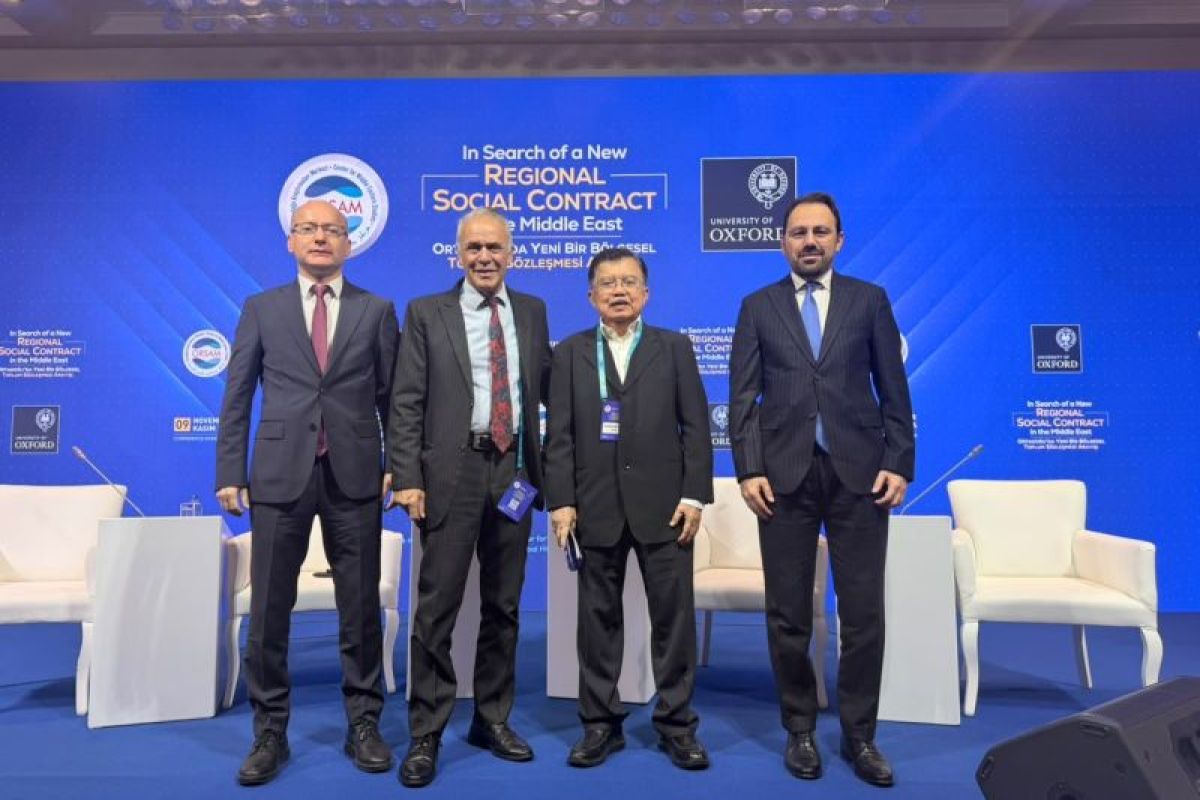
Depok, November 10, 2026 — Aceh’s peacemaking experience has once again drawn global attention. At the international conference “In Search of a New Regional Social Contract in the Middle East” held in Ankara, Türkiye, on November 8-9, 2026, Aceh was presented as a successful model of reconciliation for other nations to learn from, as reported by Herald.ID.
The forum, organized by the University of Oxford in collaboration with ORSAM (the Turkish Center for Middle East Studies), brought together approximately 200 participants from various countries, including academics, diplomats, experts, and peace practitioners.
M. Jusuf Kalla (JK), Chairman of the UIII Board of Trustees and Indonesia’s 10th and 12th Vice President, received a special invitation to deliver a keynote address. His experience in initiating the Aceh peace process was a central focus for participants seeking to understand how protracted conflicts can be resolved through political negotiation.
The invitation is closely tied to the Turkish government’s efforts to build peace and reconciliation with Kurdish resistance groups across Syria, Iraq, and Iran. Aceh is viewed as having vital experience in ending a long-standing conflict through dialogue and a comprehensive peace agreement.
Aceh Peace Documentary Screened in Ankara
The Aceh experience was introduced to participants through the screening of a documentary on the Aceh peace process on Sunday evening, November 8, 2026, local time.
The screening was followed by a dialogue featuring three key figures involved in Indonesia’s peace journey: Jusuf Kalla as the initiator of the Helsinki peace talks, Hamid Awaludin as Head of the Negotiation Team between the Indonesian Government and the Free Aceh Movement (GAM), and Dino Patti Djalal, founder and Director of the Foreign Policy Community of Indonesia (FPCI), who also served as executive producer of the documentary.
The three shared their experiences on the negotiation process, political approaches, and the factors that made the Aceh peace agreement possible.
JK: The State Must Lower Its Ego
In his presentation, Jusuf Kalla, who also serves as Chairman of the UIII Board of Trustees, explained that domestic conflicts can generally be divided into two categories.
First, horizontal conflict—disputes between community groups. Second, vertical conflict—conflict when certain groups take up arms against the state.
According to JK, both types of conflict require the state to take the initiative to open the way for peace. The government cannot simply wait for the warring parties to come to the negotiating table. It must take bold steps to engage and lower its political ego.
“The problem is, the parties involved in the conflict often have an interest in maintaining the conflict. In fact, conflict sometimes becomes a political instrument for group leaders to maintain influence over their followers,” he stated.
Therefore, conflict resolution requires political courage, a willingness to engage in dialogue, and a willingness to find common ground.
The Root of the Aceh Conflict Is Not Religion, But Economic Injustice
JK also reminded participants that understanding the root of the problem is an important step before formulating a resolution.
According to him, conflicts that appear to be religiously motivated are not necessarily rooted in religious beliefs. The real issue may be related to economic injustice and state policies.
Aceh is one example. Aceh possesses vast natural resource wealth, but its people did not enjoy prosperity commensurate with that wealth. Inequality in the management of economic resources was one of the fundamental problems that triggered prolonged conflict.
JK emphasized that the Aceh conflict was not solely driven by the desire to establish an Islamic state. There were issues of economic justice and the distribution of natural resources that needed to be resolved.
“That is why, in the peace agreement, it was agreed that Aceh would receive 70 percent of the profit sharing,” JK emphasized.
That agreement became an important part of the conflict resolution through the Helsinki Agreement signed by the Indonesian Government and GAM on August 15, 2005.
Türkiye’s Conflict Resolution Model
The conference continued on Monday, November 9, 2026, with discussions on Türkiye’s conflict resolution model and paradigm.
In that session, Jusuf Kalla appeared with Professor Talha Kose, Director of the Turkish State Intelligence Academy, and Muhammad Bhabha, a former member of parliament and peace advisor and negotiator for South Africa.
The discussion covered various approaches to conflict resolution, including the experiences of countries that have successfully ended disputes through negotiation and reconciliation.
JK’s involvement in this international forum shows that Aceh’s peace experience is still relevant in global conversations about conflict resolution.
From decades of armed conflict toward a political agreement, Aceh offers a lesson that peace requires the courage of the state to engage in dialogue, to understand the roots of injustice, and to give space to conflicting parties to build a shared future together.
That experience is hoped to inspire Türkiye in formulating a new social contract that is more inclusive and sustainable in the Middle East. []