October 26, 2026
By Dadi Darmadi
NEW HAVEN — The room in Linsly-Chittenden Hall was not large. About a hundred students and professors, notebooks open, on a crisp Friday evening in late October. At the podium stood a man who has negotiated peace in jungles, managed tsunamis, and served twice as vice president of the world’s largest Muslim-majority democracy.
Muhammad Jusuf Kalla — Pak JK to Indonesians, and Chairman of the Board of Trustees of Universitas Islam Internasional Indonesia (UIII) — did not come to Yale to talk about weapons. He came to talk about what remains when weapons fail.
“Humanity must be our main paradigm,” he said quietly. “Humanity transcends borders of country, race, ethnicity, religion, and any affiliation.”
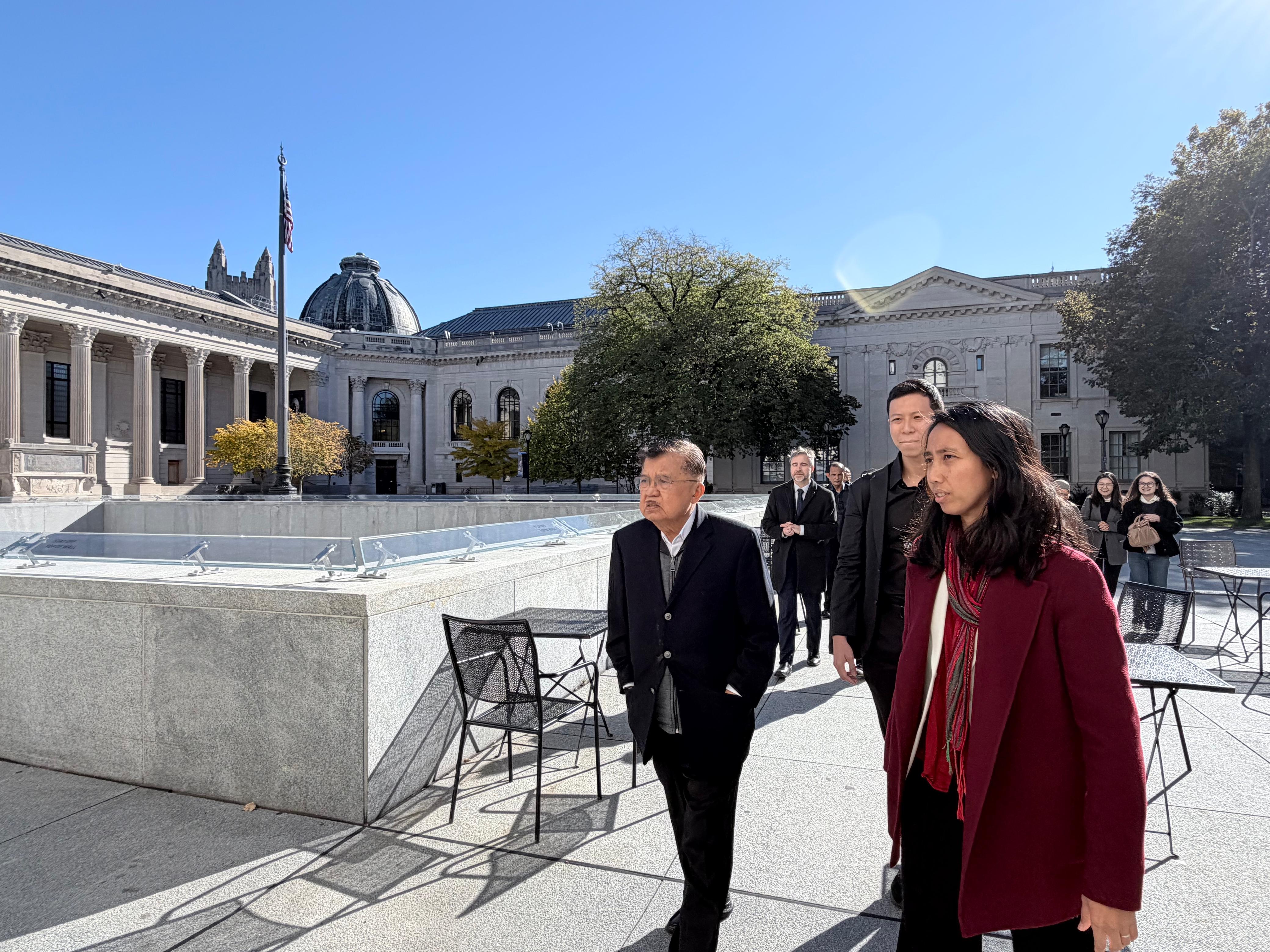
It was the final stop of a three-university American tour that took the 84-year-old statesman from the cornfields of DeKalb, Illinois, to the ivy-covered halls of Harvard and finally here, to Yale. The title of his lecture was academic — “Conflict Resolution and Peacebuilding, as well as Humanitarian and Disaster Response in Pluralistic Indonesia” — but its argument was deeply personal.
The Limits of Power
In an era obsessed with military budgets and missile ranges, Kalla offered a counter-narrative drawn from the front lines. A modern arsenal, he argued, no longer guarantees victory.
He pointed to three distant maps that now dominate Washington seminars: the grinding trench war in Ukraine where Russia’s superior firepower has stalled, the survival of Iran under years of American and Israeli pressure, the ability of the Houthis, a non-state group in Yemen, to disrupt global shipping in the Gulf.
What explains it? Not just guns, Kalla said, but _semangat_ — spirit — and strategy, and the human ability to master technology.
“It is no longer about who has the most sophisticated weapons,” he told the audience. “It is about who has the will, the knowledge, and the people to operate them.”
For students raised on the doctrine of deterrence, it was a striking reframing. Security, in Kalla’s telling, is not a technical problem to be solved by more hardware. It is a human problem, requiring dialogue, an understanding of root grievances, and, ultimately, a humanitarian lens.
It is a lesson he learned not from textbooks but from Aceh. In 2005, as vice president, he helped broker peace between the Indonesian government and the Free Aceh Movement, ending a 30-year war that had killed 15,000 people. The breakthrough did not come from a battlefield victory. It came after the 2004 tsunami — when humanity, for a moment, transcended politics.
One Disaster Breeds Another
That theme — that one crisis breeds another — ran through the second half of his lecture, the part closest to his current work as Chairman of the Indonesian Red Cross (PMI) and as Chairman of the UIII Board of Trustees.
Kalla warned of a different kind of war, slower but just as devastating: climate.
He spoke of El Niño, a word familiar to Midwestern farmers but existential in Indonesia. A drought in one province, he explained, does not stay there. It kills a rice harvest, it raises food prices in Jakarta, it pushes a family in Sumatra into debt. A forest fire in Kalimantan in August becomes a flood and landslide in Java in December.
“One disaster will bring other disasters,” he said, his voice sharpening. “Disaster management must not be sporadic.”
He was speaking to Americans, but his prescription was clearly for his own country: Indonesia needs systematic, risk-mapped, unglamorous planning. Not just emergency response after the cameras arrive, but coordination, logistics, and economic foresight before the rain fails.
It is a message that fits neatly with the university he helps lead. UIII, built in Depok on the outskirts of Jakarta, was founded on the idea that Indonesian Islam — pluralistic, moderate, disaster-tested — has something to teach the world.
At Yale, that idea came full circle. An Indonesian leader, formed by coups, tsunamis, communal conflicts and democratic compromises, standing before American students, arguing that the most advanced nation in the world still needs the oldest lesson: that in the face of war, hunger, or flood, humanity has to come first. []