August 11, 2026
By Dadi Darmadi
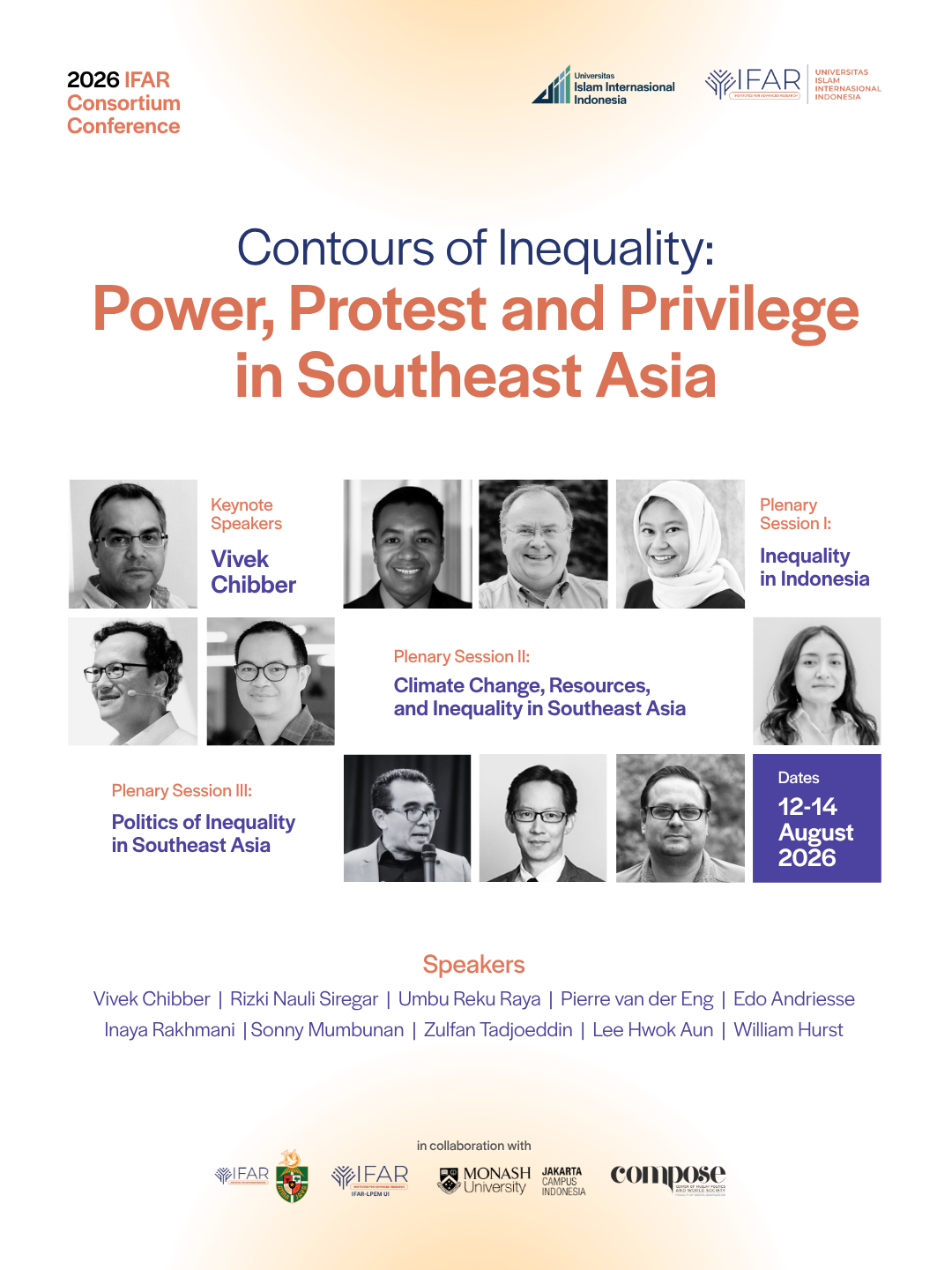
Depok, August 11, 2026 — Scholars, researchers, and policy experts from Indonesia and abroad will gather at Universitas Islam Internasional Indonesia (UIII) this week for an international conference examining one of the defining challenges of our time: inequality.
The 2026 IFAR Consortium Conference, “Contours of Inequality: Power, Protest, and Privilege in Southeast Asia,” will take place from August 12 to 14, bringing together scholars from different disciplines and countries to explore how inequality is being produced, experienced, and contested in a rapidly changing world.
The conference comes at a moment when the meaning and experience of inequality are being reshaped by profound global transformations. Climate change, technological disruption, artificial intelligence, changing labour markets, migration, economic restructuring, and shifting political conditions are creating new forms of vulnerability, often alongside longstanding structures of privilege and exclusion.
Against this backdrop, the conference asks a broader question: How are the contours of inequality changing, and what do these changes mean for societies in Southeast Asia and beyond?
The conference will open with a keynote by Vivek Chibber, Professor of Sociology at New York University and a leading scholar of development, political economy, and social theory.
Chibber will deliver the keynote, “What was Industrial Policy?” His presentation offers a timely starting point for a conference concerned with the relationship between economic transformation, development, and inequality.
His scholarship has examined state-building, late industrialization, capitalism, class, and development, questions that remain highly relevant as Southeast Asian societies navigate new economic and technological transformations.
The keynote will be followed by Plenary Session I: “Inequality in Indonesia,” bringing together three scholars who approach the question from different perspectives.
Pierre van der Eng of the Australian National University will discuss “Indonesia: Increasing Wealth Inequality 1990–2025.” Umbu Reku Raya of Sumba Cendekia Bestari will examine the structural drivers and reproduction of disadvantage in Eastern Indonesia, while Zulfan Tadjoeddin of Western Sydney University will offer a comparative perspective on economic inequality in Indonesia and the Philippines.
Together, the presentations will move the discussion from broad questions about inequality toward the historical, regional, and structural processes through which disparities are produced and reproduced.
The conference will also turn to another increasingly urgent dimension of inequality through Plenary Session II: “Climate Change, Resources, and Inequality in Southeast Asia.”
The session will feature Edo H.S. Andriesse of Seoul National University on socio-spatial and socio-environmental inequalities in Southeast Asia, Inaya Rakhmani of the University of Indonesia on the cultural political economy of climate inequality in Indonesia, and Sonny Mumbunan of UIII on sea-level rise and subnational inequality.
Their contributions point to an increasingly important reality: environmental crises do not affect all communities equally. Vulnerability is shaped by geography, resources, institutions, and the capacity of communities to adapt.
The final day will turn explicitly toward politics through Plenary Session III: “Politics of Inequality in Southeast Asia.”
Rizki Nauli Siregar of the University of Indonesia will examine whether Indonesia is growing inclusively, while Lee Hwok Aun of the ISEAS–Yusof Ishak Institute will explore the apparent paradox of falling inequality alongside rising insecurity in Southeast Asia.
William Hurst of the University of Cambridge will also contribute to the discussion, bringing a broader perspective on the political dimensions of inequality in the region.
Taken together, the three plenaries illustrate the conference’s central intellectual ambition: to understand inequality not merely as a difference in economic outcomes, but as a question of power, institutions, opportunity, security, and political voice.
For UIII, the conference provides an opportunity to bring international scholarship into conversation with some of the most pressing challenges facing Indonesia, Southeast Asia, and the wider world.
The question is no longer simply whether inequality exists. It is also whether new forms of inequality are emerging faster than societies can respond to them, and whether existing institutions are equipped to address them.
From August 12 to 14, scholars from different disciplines and national contexts will explore the changing relationship between power, protest, and privilege, and consider what these forces mean for the future of a more just and inclusive Southeast Asia.
The conference will also feature a gala dinner for speakers and participants on the evening of August 12, providing an opportunity for continued exchange alongside the formal academic program.