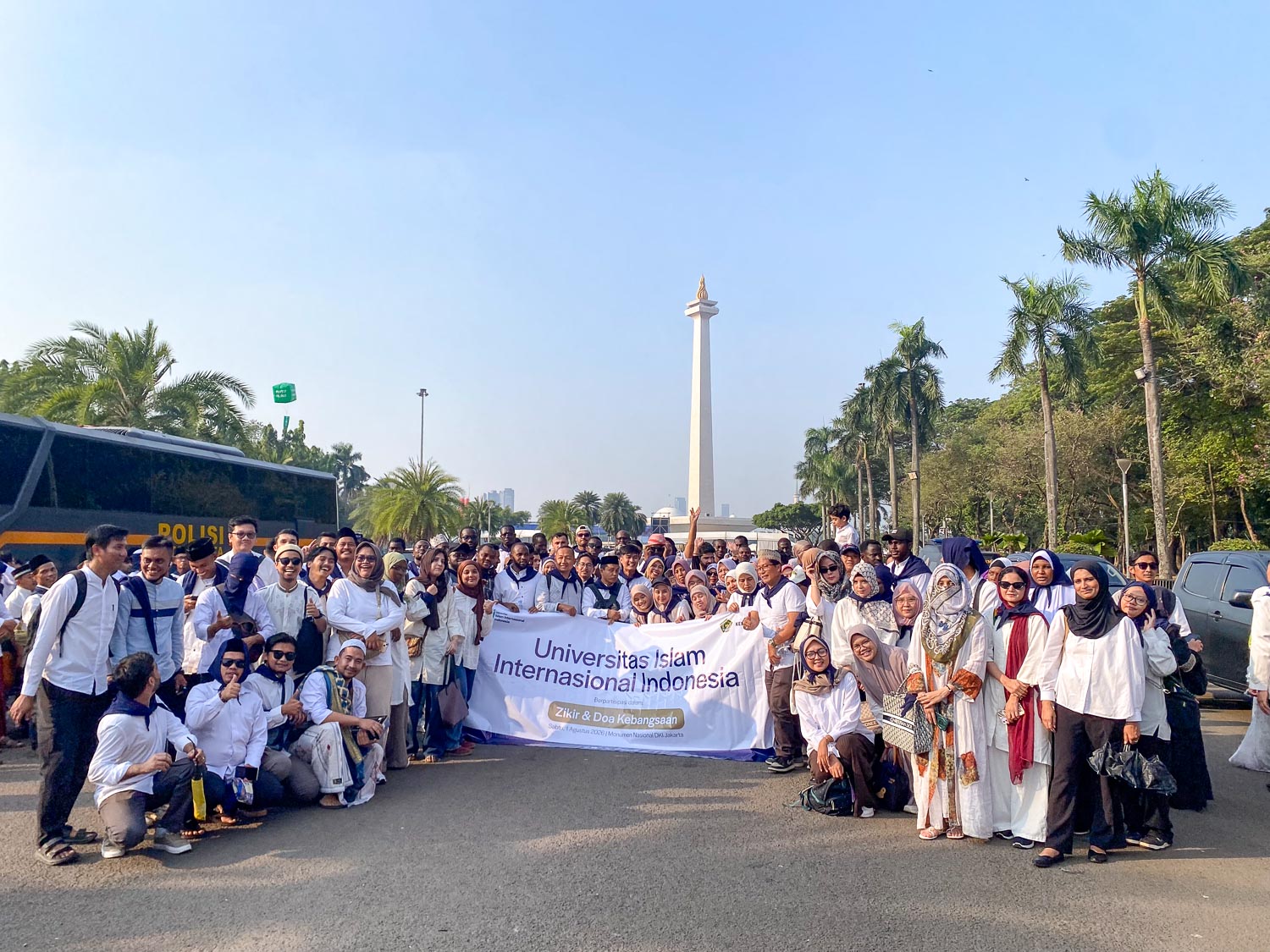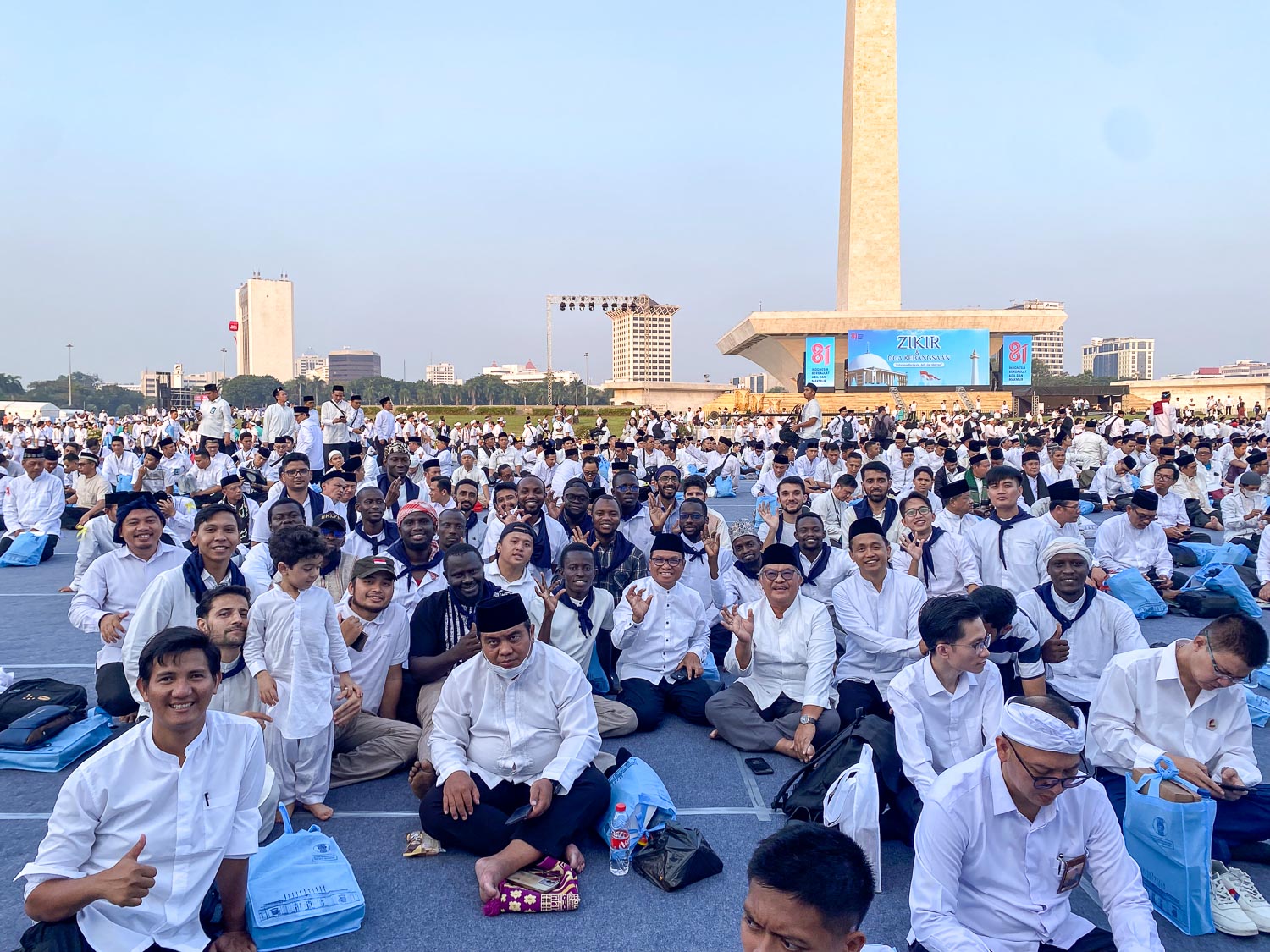
Jakarta — For around 300 members of the Universitas Islam Internasional Indonesia (UIII) academic community, Saturday evening, August 1st, 2026, offered a remarkable opportunity to experience Indonesia’s religious diversity in one of the country’s most iconic public spaces.
They joined the Zikir dan Doa Kebangsaan at the National Monument (Monas), Jakarta, held as part of the opening of celebrations for the 81st anniversary of Indonesian independence.
The gathering brought together religious leaders, government officials, students, academics, and members of the public in a collective moment of prayer and reflection. For UIII, however, the event carried a significance that went beyond participation in a national ceremony.
It offered a living experience of one of Indonesia’s most important principles: different religious communities can maintain their distinct traditions while coming together in a shared commitment to the nation.
Six Religions, Six Traditions, One Indonesia
Perhaps the most remarkable feature of the evening was the interfaith national prayer involving representatives of all six religions officially recognized by the Indonesian state: Protestant Christianity, Catholicism, Hinduism, Buddhism, Confucianism, and Islam.
Rather than simply being present as an audience, representatives of each tradition were given a role in the ceremony and offered prayers according to their own religious traditions.
The sequence began with Pdt. Jacklevyn Frits Manuputty representing Protestant Christianity, followed by Romo Fransiskus Yance Sengga, S.Fill., Lic.Th. for Catholicism. Hindu prayers were led by Pinandita Gede Pastika, followed by Buddhist prayers from Bhikkhu Bhadranatha, Thera. The Confucian prayer was led by Xs. Budi S. Tanuwibowo, while the interfaith prayer sequence concluded with H. Husni Ismail representing Islam.
The arrangement was significant precisely because it did not require religious differences to disappear.
Each community prayed in accordance with its own tradition, while all shared the same national space and the same broad hope for Indonesia’s peace, unity, and prosperity.
In this sense, the event may be regarded as a rare and perhaps unprecedented expression of Indonesia’s religious diversity in a national ceremonial setting—six recognized religious traditions actively participating in a common event while retaining their own identities and forms of worship.
Nasaruddin Umar: Prayer, Character and Action
Minister of Religious Affairs KH Nasaruddin Umar placed the gathering within a broader understanding of how a nation should approach its independence.
For him, national prayer is not an alternative to action. Rather, spirituality should provide the moral foundation for action and service. “Dengan zikir kita menumbuhkan hati, dengan doa kita mengetuk langit, dan dengan kerja serta pengabdian kita membangun bumi,” Nasaruddin said.
The message captures the spirit of the evening: remembrance should shape the heart, prayer should express hope, and work and service should translate that hope into reality.
Nasaruddin emphasized that a great nation is built not only through material development, but also through prayer, moral character, harmony, and solidarity among its citizens.
For a university community, the message has particular resonance. Education produces knowledge and expertise, but the ultimate value of education lies in how those capabilities are used for society. The participation of UIII’s academic community therefore represented an opportunity to connect knowledge, faith, and public responsibility.
From Khatmil Qur’an to Selawat Kebangsaan
The evening began with the recitation of the Qur’an, including verses 1–14 of Surah Ar-Rahman, recited by Muhammad Zian Fahrezi, the first-place winner of the 2026 International Al-Ameed MTQ in Karbala, Iraq.
The program was preceded by a Khatmil Qur’an led by KH Rijal Ahmad Rangkuti, followed by the Khatmil Qur’an prayer led by Ustaz H. Muzakkir Abd Rahman.
The spiritual atmosphere continued through the interfaith prayers and culminated in Selawat Kebangsaan, led by the prominent Indonesian religious figure Habib Syech bin Abdul Qodir Assegaf. Together with the thousands of worshippers present, Habib Syech led the gathering in selawat, transforming the large public space around Monas into a shared expression of devotion and gratitude.
The presence of figures such as Nasaruddin Umar and Habib Syech also gave the evening a distinctive character: it brought together state leadership, religious authority, popular Islamic spirituality, and Indonesia’s broader religious communities.
Voices from Indonesia’s Religious Communities
The significance of the interfaith prayers was also reflected in the comments of several religious leaders who participated in the event.
Romo Agustinus Heri Wibowo, Pr, Chair of the Justice and Peace Commission of the Archdiocese of Jakarta, described prayer as a foundation for the nation’s life. He emphasized that national efforts and cooperation should be grounded in prayer so that the work of Indonesians may receive God’s blessing and guidance.
From the Hindu community, Pinandita Gede Pastika, Chairman of Pinandita Sanggraha Nusantara, highlighted the importance of the gathering as a means of strengthening harmony amid Indonesia’s diversity. For Bhikkhu Bhadranatha, Thera, Deputy Secretary General of the Indonesian Supreme Sangha Council, the interfaith prayer represented the face of an Indonesia capable of maintaining unity amid diversity. He emphasized the importance of cultivating compassion and the values of Pancasila.
Meanwhile, Xs. Budi S. Tanuwibowo, Chairman of the Supreme Council for Confucian Religion in Indonesia, offered a particularly evocative image. Religious differences, he suggested, should not become a source of conflict. They can instead resemble an orchestra: different instruments producing different sounds, but coming together harmoniously because they share one common song—Indonesia.
That metaphor captures something fundamental about the evening at Monas. Unity did not require uniformity.
Why This Matters for UIII
For the approximately 300 members of the UIII community attending the event, this was more than a symbolic outing.
UIII is an international Islamic university whose community includes Indonesians and members of different national and cultural backgrounds. Its academic mission is to study Islam and Muslim societies through global perspectives while remaining deeply connected to Indonesia.
The Monas gathering provided an opportunity to experience Indonesian pluralism not simply as an academic subject, but as a lived social reality. Students and academics could see religious diversity unfolding in a public setting: different traditions, different prayers, different religious authorities, yet one shared national space.
This experience is particularly relevant to UIII because the university seeks to prepare graduates who can engage with both Muslim communities and the wider world. Understanding religious diversity is not only an intellectual exercise. It requires the ability to encounter difference with confidence, respect, and empathy. The evening at Monas offered precisely such an encounter.
Rahmatan lil ‘Alamin in Practice
The experience also resonates deeply with UIII’s commitment to the principle of Rahmatan lil ‘Alamin—Islam as a source of mercy and benefit for all.
The concept takes on a tangible meaning when religious communities come together without requiring one another to surrender their identities.
The six traditions represented at Monas did not pray in the same way. They prayed according to their own traditions.
Yet they shared a common aspiration: a peaceful, united, prosperous, and just Indonesia.
For UIII, this provides an important lesson about the relationship between religious identity and citizenship.
Strong religious commitment and respect for pluralism need not be opposites. Faith can instead become a source of ethical responsibility, compassion, and commitment to the common good.
Learning Beyond the Classroom
For the UIII community, participation in the National Dhikr and Prayer can also be understood as a form of learning beyond the classroom.
Universities teach students to read texts, conduct research, analyze societies, and engage with complex ideas. But some forms of knowledge are acquired through experience.
Standing together with fellow citizens at Monas, listening to prayers from six religious traditions, hearing religious leaders speak about harmony and compassion, and joining in national selawat offered a different kind of education. It was an education in citizenship, pluralism, spirituality, and belonging. For an international university, this is particularly valuable.
UIII does not merely seek to introduce Indonesia to the world through scholarship. It also seeks to expose its international community to Indonesia as a lived experience—a society in which religious identity, national identity, and cultural diversity constantly interact.
From Monas Back to the Campus
As the evening came to an end, the approximately 300 members of the UIII community returned to their campus in Depok carrying an experience that cannot easily be captured in a lecture or textbook.
They had witnessed a national gathering in which the country’s six officially recognized religions were represented and actively participated according to their own traditions.
They had listened to the Minister of Religious Affairs speak about prayer, moral character, and service. They had joined Habib Syech in Selawat Kebangsaan. And they had shared a public space with religious leaders and fellow citizens from different backgrounds.
For UIII, their participation was therefore more than institutional attendance.
It was a reflection of the university’s broader mission: to connect Islamic scholarship with humanity, faith with knowledge, and Indonesia with the wider world.
The evening at Monas offered a powerful reminder that Indonesia’s diversity is not simply something to be managed. At its best, it can be celebrated as a source of strength.
Different prayers. Different traditions. Different communities.
One Indonesia. []