July 18, 2026
By Dadi Darmadi
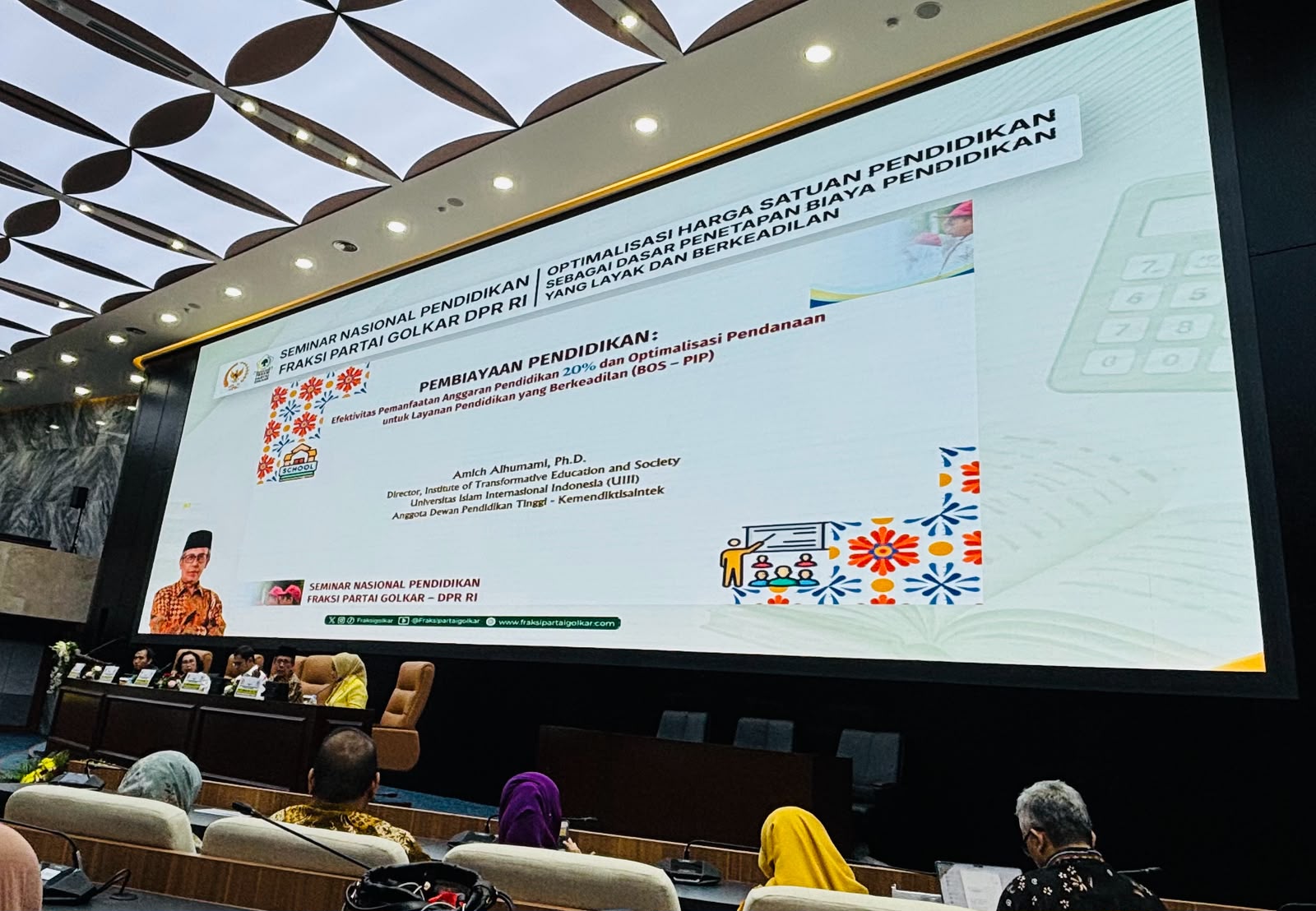
Jakarta — Dr. Amich Alhumami, Director of the Institute for Transformative Education and Society (ITES) at Universitas Islam Internasional Indonesia (UIII), underscored the need for Indonesia to fundamentally rethink how it finances education during a National Education Seminar held recently at the Indonesian House of Representatives (DPR RI). The seminar, organized by the Golkar Party’s parliamentary faction, brought together policymakers, academics, education practitioners, and civil society representatives to discuss “Optimizing Education Unit Costs as the Basis for Determining Fair and Adequate Education Financing,” in Jakarta on July 13, 2026.
Speaking alongside prominent figures including Prof. Unifah Rosyidi (Chairperson of the Indonesian Teachers Association/PGRI), Irsyad Zamjani, Ph.D. (Center for Standards and Education Policy, Ministry of Primary and Secondary Education), Abdullah Ubaid Matraji (National Coordinator of the Indonesian Education Monitoring Network/JPPI), and Amalia Adininggar Widyasanti (Head of Statistics Indonesia/BPS), Dr. Amich emphasized that education financing should no longer be viewed merely as an annual budgeting exercise. Instead, he argued that it should be recognized as a strategic investment in Indonesia’s long-term human capital development.
In his presentation, Dr. Amich highlighted three interrelated challenges that continue to shape Indonesia’s education system: accessibility, affordability, and quality. While Indonesia has made significant progress in expanding educational participation over the past decades, he noted that these three dimensions remain unevenly addressed across regions and social groups.
“Expanding access alone is not enough,” he stressed. “Children must also be able to afford schooling, and schools must have sufficient resources to provide quality learning.”
Dr. Amich further explained that discussions on education financing should move beyond simply debating the size of the education budget. More importantly, policymakers need to ensure that available resources are allocated in ways that effectively improve educational opportunities and learning outcomes.
Drawing on the 2026 State Budget, he noted that Indonesia allocates Rp769.09 trillion to education, including Rp264.63 trillion transferred directly to regional governments. According to him, this substantial allocation reflects the government’s constitutional commitment to education. Nevertheless, he emphasized that the central challenge is no longer merely how much Indonesia spends on education, but whether those resources are allocated effectively to improve educational quality and learning outcomes.
Dr. Amich further observed that education spending remains dispersed across approximately 20 ministries and government agencies, which together receive around Rp276.3 trillion in education-related allocations. While acknowledging that these institutions support various education-related functions, he suggested that education financing should primarily be concentrated within ministries that carry the constitutional mandate to organize education. These include the Ministry of Religious Affairs (Rp75.6 trillion), the Ministry of Primary and Secondary Education (Rp56.6 trillion), and the Ministry of Higher Education, Science, and Technology (Rp61.8 trillion). Such a policy, he argued, would strengthen coherence, accountability, and the overall effectiveness of education spending.
Despite these significant investments, Dr. Amich maintained that financing policies should increasingly be evaluated based on their contribution to educational quality rather than simply on the size of annual budget allocations.
One of the central messages of his presentation concerned the importance of viewing education spending as an investment rather than a recurrent expenditure. He argued that well-designed education financing contributes directly to productivity, innovation, social cohesion, and long-term economic competitiveness.
“Education financing is not simply about funding schools,” he explained. “It is about investing in the future quality of Indonesia’s human resources.”
He also emphasized that discussions on education financing should be firmly linked to Indonesia’s broader national development agenda, particularly the vision of Golden Indonesia 2045. Achieving this aspiration, he noted, requires sustained investment not only in expanding access to education but also in improving teaching quality, learning environments, educational technology, and institutional capacity.
Throughout his presentation, Dr. Amich encouraged policymakers to adopt a more evidence-based approach to financing education. Rather than relying primarily on historical budget allocations or administrative formulas, future funding mechanisms should increasingly reflect the actual resources required to deliver quality education across Indonesia’s highly diverse geographic and socioeconomic contexts.
His remarks resonated with several themes raised by other speakers during the seminar. While Irsyad Zamjani presented evidence on disparities between existing School Operational Assistance (BOSP) allocations and schools’ actual operational costs, Amalia Adininggar Widyasanti demonstrated significant variations in household education expenditure across provinces. Abdullah Ubaid Matraji highlighted the constitutional dimension of education financing as a public right, while Prof. Unifah Rosyidi emphasized the importance of ensuring that school funding reflects the realities faced by teachers and schools on the ground.
Together, the discussions converged on a shared conclusion: Indonesia’s education financing system should evolve toward a more evidence-based, needs-sensitive, and equitable model that recognizes differences in geography, school characteristics, and learners’ socioeconomic backgrounds.
For UIII, Dr. Amich’s participation reflects the university’s growing contribution to national policy dialogue. As Director of ITES, he continues to bridge academic research and public policymaking by bringing evidence-informed perspectives to some of Indonesia’s most pressing educational challenges.
The seminar also reaffirmed UIII’s broader mission of serving as a global center for scholarship that contributes practical solutions to public policy issues. Through the work of ITES, UIII seeks to advance transformative ideas that support equitable, inclusive, and high-quality education while strengthening evidence-based policymaking in Indonesia and beyond.
As Indonesia continues to refine its education financing policies, the discussions at the National Education Seminar demonstrated the importance of integrating rigorous research, reliable statistics, and policy innovation into future reforms. Dr. Amich Alhumami’s presentation highlighted that sustainable improvements in education will depend not only on increasing public investment but also on ensuring that education resources are strategically allocated to institutions with constitutional responsibility and distributed according to the real costs of delivering quality education and achieving meaningful learning outcomes.