June 9, 2026
By Aliva Erhan
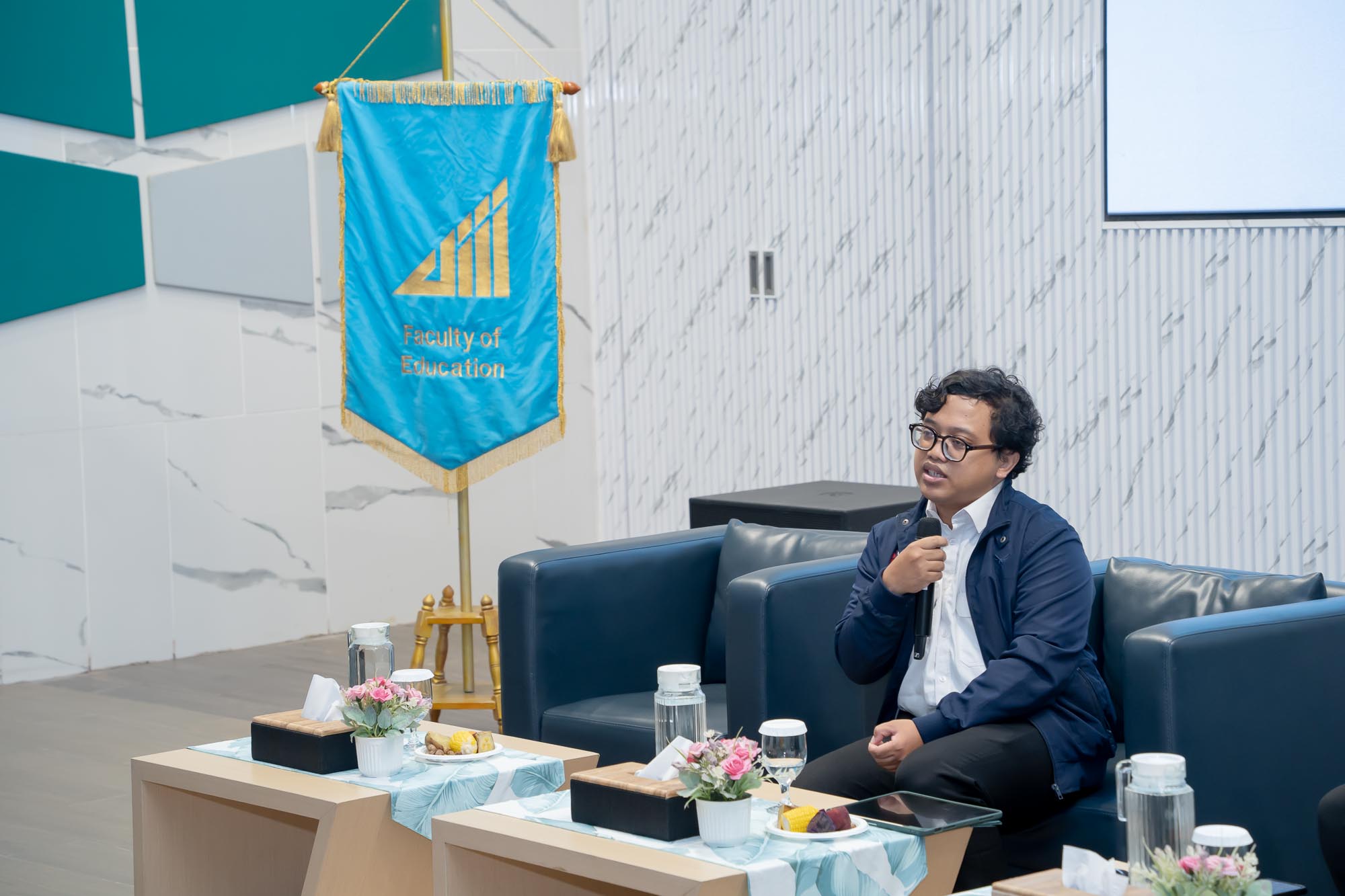
A screenshot of an international bank transfer flashed across the screen during Keynote Session 2 on the first day of the Graduate Forum and Colloquium 2026, Wednesday, June 3rd, 2026. The amount was more than two thousand euros. The audience looked on with curiosity as Dr. Soeharto used that image to illustrate a simple yet powerful point, that sustained research productivity can open doors to opportunities that many early-career researchers might never expect.
Dr. Soeharto from Indonesia’s National Research and Innovation Agency (BRIN) was the second keynote speaker on the first day of the Graduate Forum and Colloquium 2026, organized by the Faculty of Education UIII. Discussing “Thriving in Academia: Maximizing Research Productivity with Integrity,” he invites students and lecturers to see academic productivity from a broader point of view, not only massive numbers of publications, but also includes intellectual habits, meaningful collaboration, and commitment to academic integrity. Drawing on his experience as a researcher affiliated with BRIN, Johannes Kepler University in Austria, and Azerbaijan State Economic University (UNEC), he reflected on building an academic career across institutions and countries. What is remarkable is that his bright achievements are built on simple yet consistently performed practices.
Reading as Knowledge Foundation and Collaboration
Dr. Soeharto emphasized that reading is the core foundation that supports the entire academic process. He encouraged participants to keep up with the latest research developments through reputable journals and to make reading a sustainable habit. He also demonstrated how reading activities can be a collective process. He initiated an online reading group involving researchers, colleagues, and students from various institutions. Through this group reading activity, scientific articles can be discussed together, and thus, everyone gains more, as understanding can be deepened, assumptions can be questioned, and new perspectives can emerge through dialogue.
For him, good research productivity hardly comes from fully independent work. That is why, beyond reading, he also emphasizes the importance of building academic connections through mentoring and serving as a reviewer. Academic productivity can grow more through mutually supportive relationships.
The importance of Publication Mapping
Networking and collaboration alone, however, are not enough. Academic productivity also requires careful planning. This is what sometimes escapes the attention of the academic community. Dr Soeharto emphasized the importance of having publication mapping and planning, that each publication needs to be monitored in its progress; from the status, revision progress, submission target, to the predicted publication date. This can greatly facilitate researchers in getting a big picture of what they are working on, avoiding abandoned projects, maintaining productivity direction, and more strategically managing their time.
The Art of Balancing Academic and Personal Life
Within the discussion on publication targets, research collaboration, and strategies for maintaining productivity, Dr. Soeharto also included a more personal reflection. Through a photo with his wife and child displayed on the screen, he shared a principle that has guided him throughout his academic journey, “Family comes first, but academic responsibilities and contributions still matter.” This message serves as a reminder that, academic productivity does not have to be built at the expense of personal life. Success in the academic world should go hand in hand with responsibilities toward family and life outside the campus.
AI Navigation and Research Ethics Boundaries
The next topic that also caught the participants’ attention was the use of AI in the academic world. For a long time, Dr. Soeharto has been advocating the importance of ethical AI use in academic writing. AI is a tool that can help researchers work more effectively, but there are still boundaries that must not be crossed. AI cannot be listed as an author, cannot replace the peer review process, and its use must be disclosed transparently when relevant. In addition, Dr. Soeharto also repeatedly emphasized the importance of research integrity. He presented several examples of ethical violations that had attracted public attention and explained the importance of the ethical clearance process in research. Meaningful academic productivity must be built on the credibility and scientific honesty that underlie it.
Maximizing Global Opportunities
In addition to publications, participants are also invited to take advantage of various academic development opportunities, including research grants, mentoring programs, and international conferences. In his presentation, he introduced various grant schemes available through BRIN and encouraged participants to regularly monitor research funding information through the National Research and Innovation Funding Portal (RISPROV/RISNOV) BRIN. Dr. Soeharto also shared his experiences attending global scientific forums and introduced travel grant opportunities that can help students and young researchers participate in international conferences. One of the examples he presented was the Junior Researchers of EARLI (JURE) Conference, a prestigious forum for young researchers in the field of education.
Finally, the lessons from Dr. Soeharto’s session were surprisingly simple. Thriving in academia is about cultivating habits that sustain long-term growth. As the session came to a close, participants were reminded that academic success is measured not only by what researchers produce, but also by how they produce it.