November 23, 2026
By Achmad Jatnika
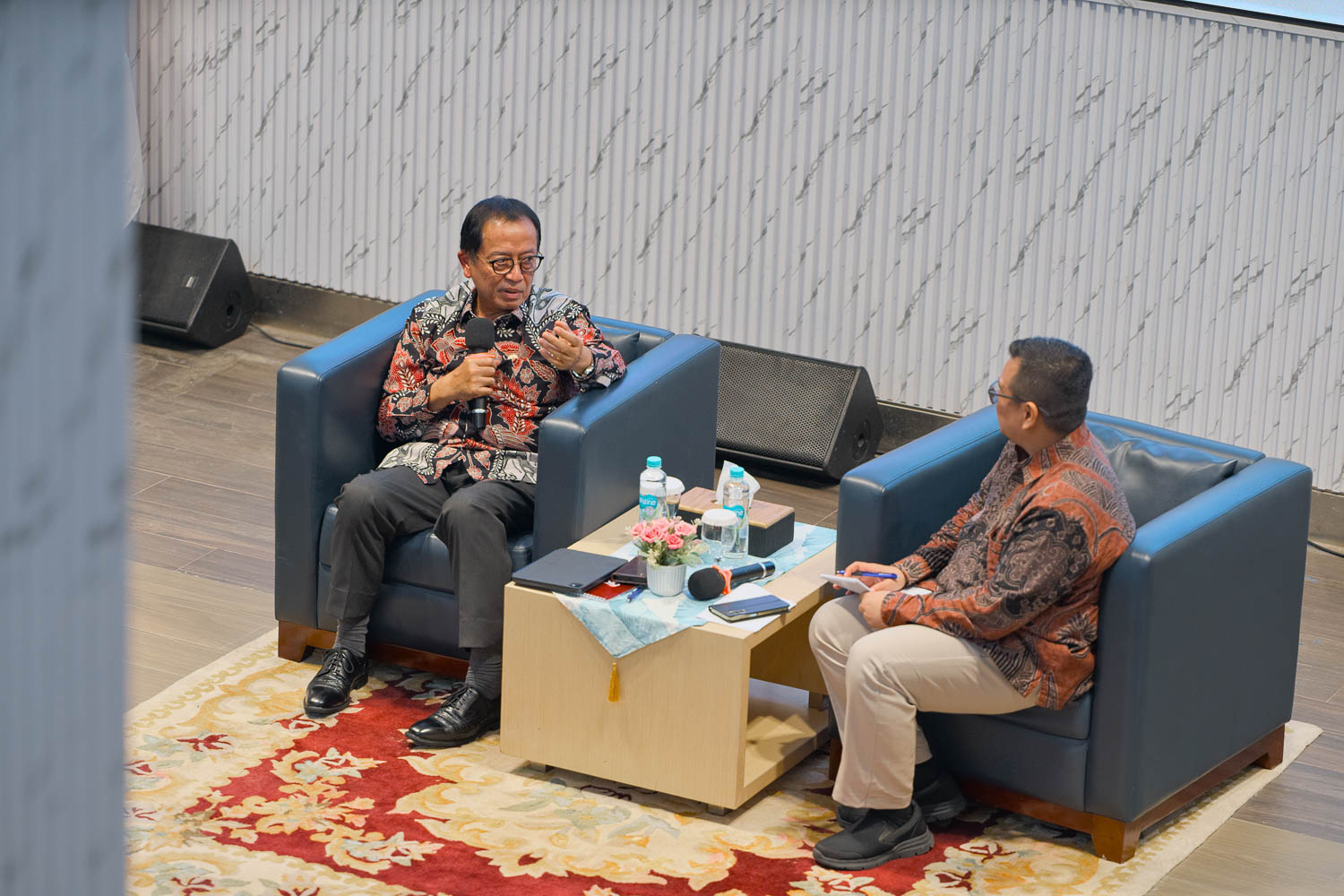
Depok – Indonesia’s Financial Services Authority (OJK) partnered with the Faculty of Economics and Business at UIII (FEB UIII) to host the OJK Mengajar public lecture in Depok on Thursday, November 19, 2026. Chief Executive of Banking Supervision at OJK, Dian Ediana Rae, was the keynote speaker for the event, accompanied by the head of M.Fin in Sustainable Finance of UIII, Dr. Rizky Wisnoentoro. In the lecture, Dian outlined how Indonesia navigates global economic volatility while building a forward-looking, sustainable, and inclusive financial system.
He warned that the world economy has retreated from the predictable, rule-based multilateral trade system established in 1995. Citing reciprocal tariffs, supply chain disruptions, and ongoing geopolitical conflicts in the Middle East and Eastern Europe, Dian noted that developing nations must brace for prolonged market volatility.
“We are living in a very dynamic and volatile world. We have to fasten our seatbelts and be ready for a bumpy road ahead,” said Dian.
Despite capital market fluctuations and pressure on the Rupiah, Dian highlighted that Indonesia has maintained economic growth of around 5%, a performance he described as well above the global average. He attributed the banking industry’s resilience to strict prudential standards and Basel-aligned supervision instituted following the 1998 Asian Financial Crisis.
Because commercial banks account for approximately 80% of Indonesia’s total financial assets, OJK is rolling out new banking roadmaps focused on building economies of scale and modernizing financial services.
Key initiatives outlined by Dian include aggressive banking consolidation, universal banking adoption, AI governance, and cybersecurity. OJK views the current 105 commercial banks as excessive and aims to reduce that figure by roughly 50% to strengthen capital capacity for financing large-scale national projects. Consolidation is already underway among rural banks (BPR), which have decreased from 1,600 to around 1,200.
Dian also addressed structural challenges in Indonesia’s Islamic finance industry. While Indonesia is the world’s largest Muslim-majority nation, Islamic banking represents only about 7% of total banking assets. National survey data shows that while Islamic financial literacy has reached 43%, actual inclusion stands at just 13%.
To close that gap, OJK established a dedicated Islamic Finance Development Department and an Islamic Finance Development Committee. Dian revealed that plans are already in motion to establish three additional large-scale Islamic banks, similar in stature to Bank Syariah Indonesia (BSI), which are expected to take effect next year. OJK is also encouraging digital Islamic banks to expand access across Indonesia’s archipelago and integrate Sharia finance directly with the halal industry and takaful (Islamic insurance).
Responding to questions on environmental risks and non-bank financial stability, Dian pointed to OJK’s revised, streamlined sustainability taxonomy, categorizing activities into “green” and “transition”, alongside newly issued green building financing guidelines. To accelerate renewable energy adoption without triggering greenwashing, OJK is prepared to offer regulatory incentives, such as lower risk-weighted asset (ATMR) requirements, mirroring existing policies for electric vehicle financing.
Additionally, to boost public trust and disaster insurance penetration in earthquake- and flood-prone regions, Dian noted that the Indonesia Deposit Insurance Corporation (LPS) is expanding its mandate under UU P2SK to guarantee insurance policies alongside bank deposits.
“Financial stability is the backbone of economic growth,” Dian concluded, emphasizing that predictable policies and international standards remain essential to keeping Indonesia competitive for global investors.
