October 20, 2026
By Dadi Darmadi
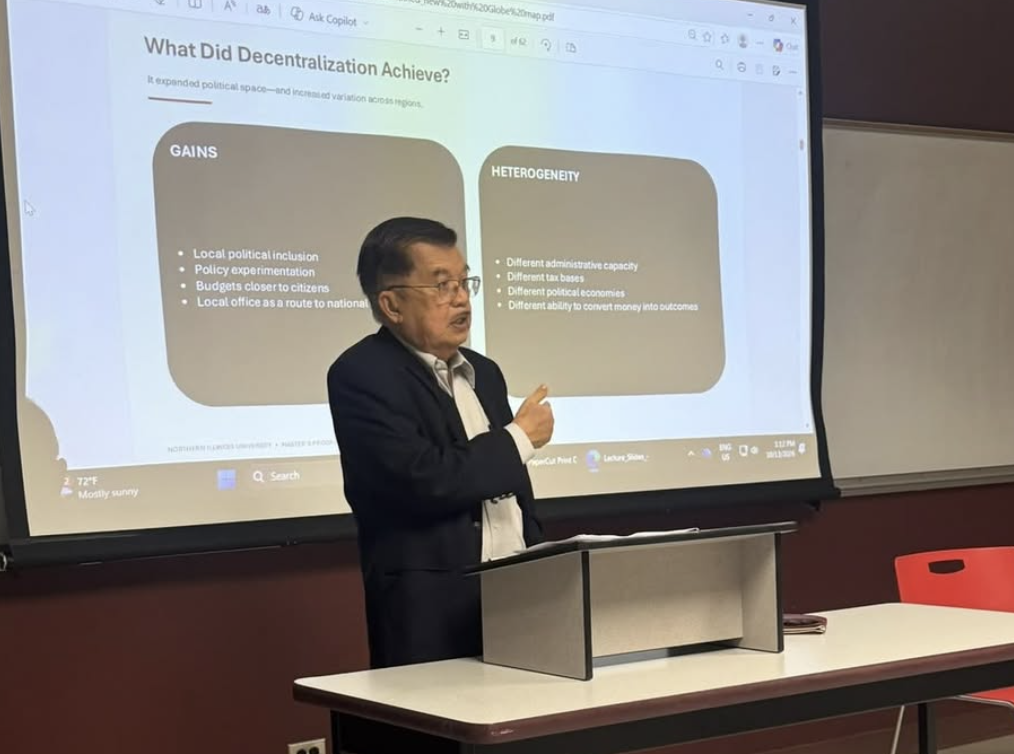
DeKalb, Illinois — Jusuf Kalla did not travel to the American heartland to deliver a victory lap. In his lecture at Northern Illinois University, the former vice president offered a critique of Indonesia’s post-Reformasi democracy that was as pointed as it was personal. “Liberal democracy after the reform era opened up political competition,” he told the audience, “but it has not always been matched by adequate experience and capacity”. The consequence, he argued, is a system where “in the election process, popularity and financial capability tend to be more decisive than competence and the quality of leadership”.
This is not a new theme for Kalla. He has long warned that the opening of political space after 1998, while historic, created new vulnerabilities. In his NIU lecture, he connected the dots: limited educational attainment and economic pressure, he suggested, make voters more susceptible to money politics, allowing wealth and fame to eclipse merit. The critique carries particular weight coming from a man who served under two presidents—Susilo Bambang Yudhoyono and Joko Widodo—and who witnessed firsthand how electoral incentives can shape, and sometimes distort, governance.
Kalla’s diagnosis extends beyond elections to the architecture of the state itself. He traced the roots of Indonesia’s decentralization drive to the pre-reform era, when a highly centralized system stifled regional initiative and fueled demands for greater autonomy. Yet he is equally clear that autonomy is not a panacea. His prescription includes reviving the Garis Besar Haluan Negara (GBHN), the old state policy guidelines that once provided long-term direction for national development. The absence of such a framework, he argues, means that every new president arrives with a new set of programs, rendering national achievements fragmented and long-term goals unmeasurable. Crucially, Kalla insists this is not a call to return to authoritarianism: “The basic principle remains direct elections,” he said. “That is the people’s right in a democracy”.
There is also a historical reckoning in his remarks. Kalla pointed to the liberalization of Indonesia’s banking sector in the 1990s—when deregulation allowed the number of banks to balloon to around 240, often with minimal oversight—as a root cause of the 1997 economic crisis that helped bring down Soeharto. The lesson is unmistakable: markets, like elections, require strong institutions and capable stewardship to function properly.
A Diagnosis for a Global Audience
Across his American lecture tour, Jusuf Kalla is offering international audiences more than a case study of Indonesia. He is presenting a cautionary tale about the fragility of democratic transitions everywhere. The NIU lectures, the Harvard talk on leadership under uncertainty, and the Yale discussion on peacebuilding all circle a common theme: the gap between the promise of reform and the reality of governance.
Kalla’s message is uncomfortable but necessary — that democracy, to endure and deliver, must be about more than the mechanics of elections. It must be about the substance of leadership, the integrity of institutions, and the courage to correct course when the tide of popularity and money threatens to overwhelm merit. For the students and scholars gathered in DeKalb, Cambridge, and New Haven, it is a lesson worth pondering long after the lecture halls empty. []