July 8, 2026
By Dadi Darmadi
DEPOK, Indonesia — Universitas Islam Internasional Indonesia (UIII) will bring together leading scholars, researchers, and policymakers from across the globe for an international conference examining one of the most pressing challenges confronting contemporary societies: inequality.
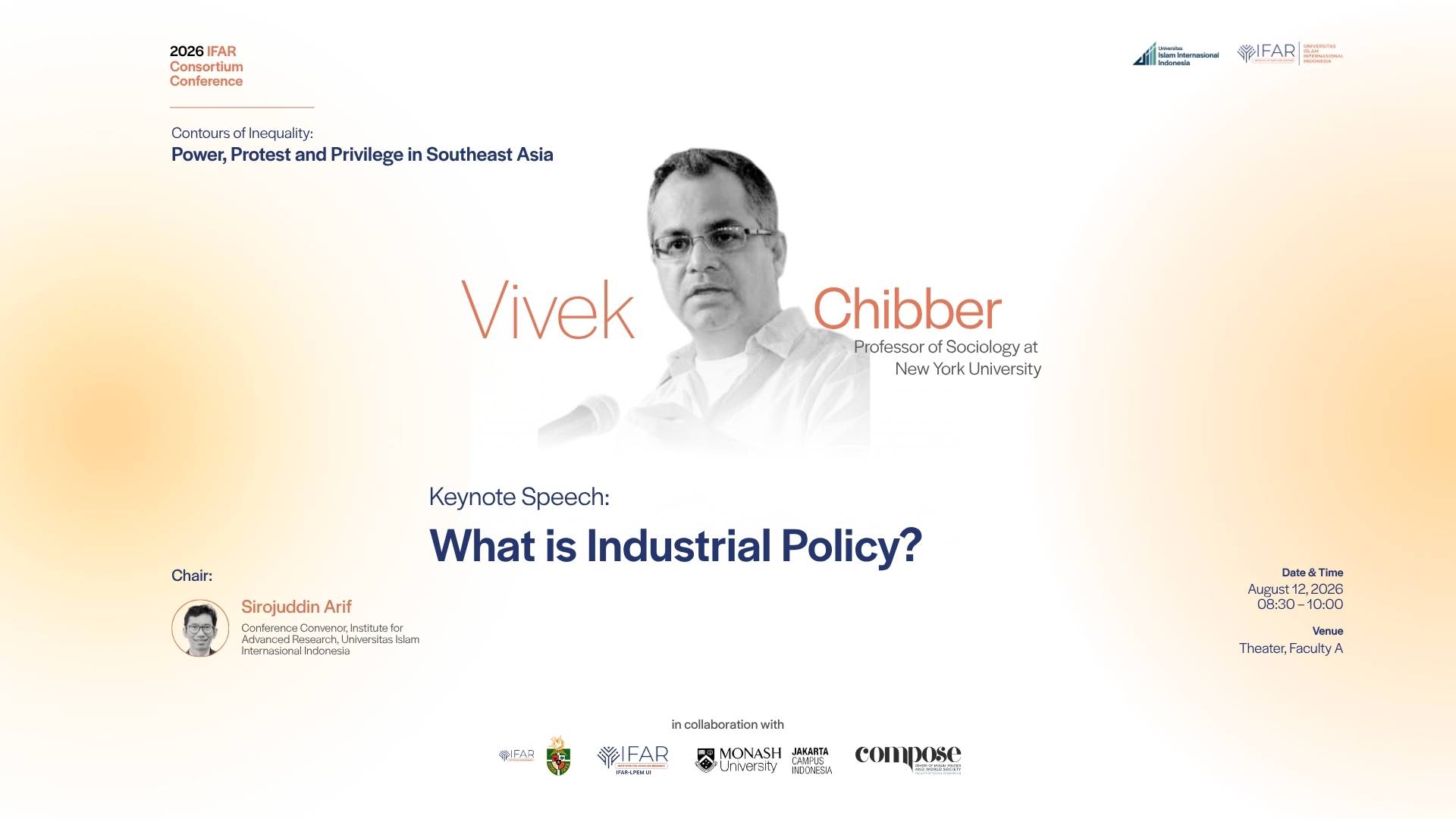
Titled “Contours of Inequality: Power, Protest, and Privilege in Southeast Asia,” the conference will take place on 14 August 2026 at the UIII campus in Depok. Organized by the Institute for Advanced Research (IFAR), the event aims to advance scholarly and policy discussions on the causes, manifestations, and consequences of inequality across Southeast Asia.
The conference will be headlined by Professor Vivek Chibber of New York University, one of the world’s foremost scholars of capitalism, class, development, and social theory. Widely recognized for his influential contributions to debates on political economy and postcolonial studies, Chibber’s work has shaped contemporary understanding of how structural inequalities emerge and persist across societies.
His keynote address is expected to offer a timely reflection on the global dynamics of inequality and their relevance to Southeast Asia, a region marked by rapid economic transformation, social mobility, and persistent disparities in wealth, opportunity, and political influence.
“Professor Chibber’s participation brings a global intellectual perspective to conversations that are deeply relevant to Southeast Asia’s development trajectory,” said Sirojuddin Arif, PhD, the chairperson of IFAR conference organizers. “His scholarship continues to influence discussions on inequality, social justice, and democratic participation across the world.”
The conference will feature a distinguished lineup of scholars whose research has significantly contributed to the study of inequality, development, and social change.
Among them is Hwok-Aun Lee of the ISEAS–Yusof Ishak Institute, Singapore, a leading authority on socioeconomic inequality, labour markets, education, and affirmative action policies in Southeast Asia. His research has provided critical insights into how public policy shapes inclusion and opportunity in diverse societies.
Joining him is Professor M. Zulfan Tadjoeddin of Western Sydney University, whose work on regional disparities, conflict, decentralization, and development economics has enriched scholarly understanding of the relationship between inequality and social stability in Indonesia and beyond.
The conference’s Indonesia-focused panel will feature Professor Pierre van der Eng of the Australian National University (ANU), an internationally respected economic historian known for his research on Indonesia’s long-term economic development. He will be joined by Rizki Nauli Siregar of the University of Indonesia and Umbu Raya Kedamaki of Universitas Nusa Cendana, whose research explores regional development, public policy, and socioeconomic challenges across the Indonesian archipelago.
Recognizing the growing importance of environmental issues in shaping social outcomes, the conference will also host a panel on climate, resources, and inequality featuring Sonny Mumbunan of UIII, Inaya Rakhmani of the University of Indonesia, and Michelle Miller of the National University of Singapore. Their work examines the intersections of environmental governance, labour relations, resource politics, and social justice.
The conference’s international reach is further reflected in the participation of scholars from leading institutions worldwide, including Edo Andriesse (Seoul National University, South Korea), Gerard McCarthy (International Institute of Social Studies, Netherlands), Jie Zhuo (Macquarie University, Australia), Buraskorn Torut (Mahidol University, Thailand), Eduwin Pakpahan (Northumbria University, United Kingdom), William Hurst (University of Cambridge, United Kingdom), Atchareeya Saisin (Chiang Mai University, Thailand), and Christopher Choong (Khazanah Research Institute, Malaysia).
The conference will explore a wide range of themes, including state-building and economic development, globalization and inequality, identity and marginality, climate and resource politics, and the broader social and political consequences of unequal development. Through keynote lectures, thematic panels, policy roundtables, and workshops for early-career researchers, participants will engage in critical discussions on how inequality is reshaping societies across the region.
The event has already attracted substantial international interest. More than 170 abstract submissions were received from scholars working on Southeast Asia and related fields, reflecting the growing importance of inequality as a subject of academic inquiry and public concern.
Beyond advancing scholarly debate, the conference seeks to strengthen regional and international research networks, generate policy recommendations, and encourage collaborative approaches to addressing inequality in Southeast Asia.
As countries across the region grapple with widening economic gaps, environmental pressures, demographic shifts, and changing political landscapes, Contours of Inequality: Power, Protest, and Privilege in Southeast Asia promises to provide a vital platform for understanding the challenges ahead and imagining more inclusive futures.
For UIII, the conference represents another important step in its mission to foster internationally engaged scholarship that addresses pressing issues facing Indonesia, Southeast Asia, and the wider world.[]