November 25, 2026
By Dadi Darmadi
Depok — Who gets to speak for Islam, and how is that right defended?
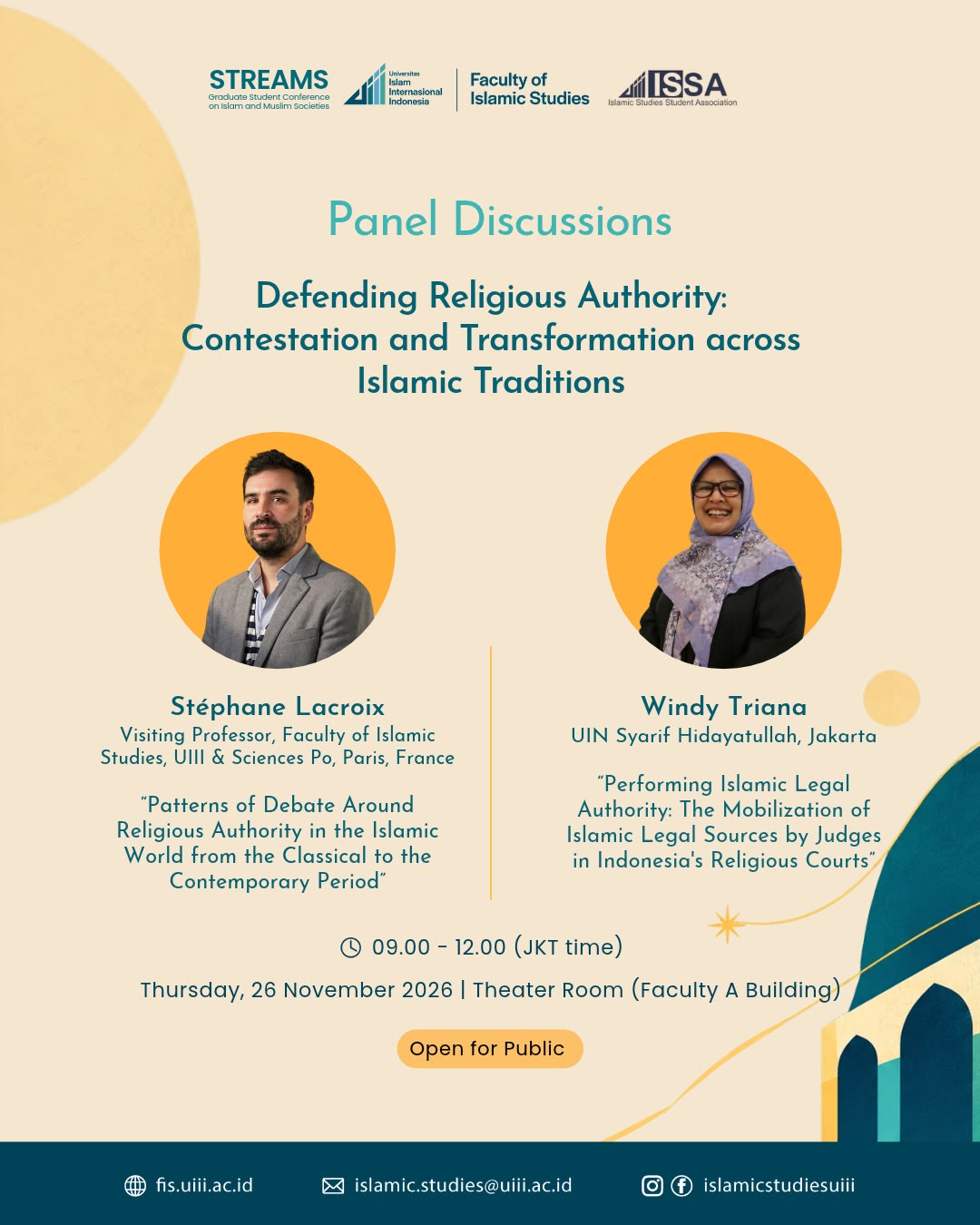
That question will anchor a panel discussion titled “Defending Religious Authority: Contestation and Transformation across Islamic Traditions,” part of STREAMS, the Graduate Student Conference on Islam and Muslim Societies, at Universitas Islam Internasional Indonesia (UIII).
The panel is organized by the Faculty of Islamic Studies and the Islamic Studies Student Association (ISSA). It will be held on Thursday, 26 November 2026, from 09.00 to 12.00 WIB, at the Theater Room, Faculty A Building, UIII, and is open to the public.
The discussion will feature two speakers with very different, but complementary, approaches to religious authority: one tracing its debate across centuries, the other observing how it is performed in Indonesia’s Religious Courts.
From Classical Debate to Contemporary Contestation
The first speaker, Stéphane Lacroix, Visiting Professor at the Faculty of Islamic Studies, UIII, and Associate Professor at Sciences Po, Paris, will present on “Patterns of Debate Around Religious Authority in the Islamic World from the Classical to the Contemporary Period.”
Dr. Lacroix is a political sociologist and a senior researcher at Sciences Po’s Centre de Recherches Internationales (CERI), where he also co-directs the Chair for the Study of Religion. Fluent in Arabic and shaped by extensive fieldwork in Saudi Arabia and Egypt, he is a renowned authority on Salafism and Islamist movements.
His publications include “Awakening Islam: The Politics of Religious Dissent in Contemporary Saudi Arabia” (Harvard University Press, 2011) and “Twilight of the Saints: The History and Politics of Salafism in Contemporary Egypt” (Columbia University Press, 2025).
In his presentation, Lacroix will trace how debates over religious authority have changed over time, from classical disputes over who could interpret the tradition, to contemporary movements that claim authority by invoking purity, direct access to texts, and new forms of preaching, publishing, and institution-building.
His central argument is that religious authority is not simply inherited. It is built, contested, and defended, again and again, in different historical settings.
Authority Performed in the Courtroom
The second speaker, Windy Triana of UIN Syarif Hidayatullah, Jakarta, will present on “Performing Islamic Legal Authority: The Mobilization of Islamic Legal Sources by Judges in Indonesia’s Religious Courts.”
Dr. Triana is a lecturer at the Faculty of Sharia and Law, UIN Syarif Hidayatullah Jakarta. Her research examines how Islamic legal authority works in practice, particularly in how judges produce legal knowledge and decide cases.
Where Lacroix looks at broad patterns across the Islamic world, Triana will bring the discussion into the courtroom. A judge, she argues, does not simply possess authority because of a position or a robe. Authority must be performed, through the careful mobilization of the Qur’an, Hadith, the Compilation of Islamic Law (KHI), Supreme Court circulars, precedent, and legal reasoning.
Her work has examined, for example, how Religious Courts handle “nafkah madiyah“, or arrear child maintenance after divorce, and why decisions can differ depending on the legal basis judges use and their assessment of a father’s ability to pay. The example shows how abstract debates about authority have concrete consequences for families seeking justice.
Together, the two presentations will offer a powerful contrast: one speaker asks how authority is debated across history, the other asks how authority is enacted in a single decision.
Why the Panel Matters
For graduate students, the panel will offer two models for studying Islam and Muslim societies.
The first model treats religious authority as political sociology: who claims it, who challenges it, and what social and historical conditions make a claim succeed?
The second model treats religious authority as legal practice: how is it produced in documents, arguments, and courtrooms, and what happens when different sources of law point in different directions?
By placing these models side by side, the panel will invite students to think beyond a single discipline. It also reflects STREAMS’ broader aim: to create a space where graduate students can engage with senior scholars, test their own research questions, and see how Islamic studies connects history, politics, law, and lived practice.
Join the Conversation
The event will reaffirm UIII’s role as a meeting point for international and Indonesian scholarship, where classical traditions, contemporary politics, and everyday legal practice can be discussed in the same room.
All students, lecturers, researchers, and members of the public interested in Islam, law, and religious authority are invited to attend and join the discussion.
Event details
Event: Panel Discussions — Defending Religious Authority: Contestation and Transformation across Islamic Traditions
Series: STREAMS, Graduate Student Conference on Islam and Muslim Societies
Organizers: Faculty of Islamic Studies, UIII and Islamic Studies Student Association (ISSA)
Date: Thursday, 26 November 2026
Time: 09.00 – 12.00 WIB
Venue: Theater Room, Faculty A Building, UIII
Open for public. []
