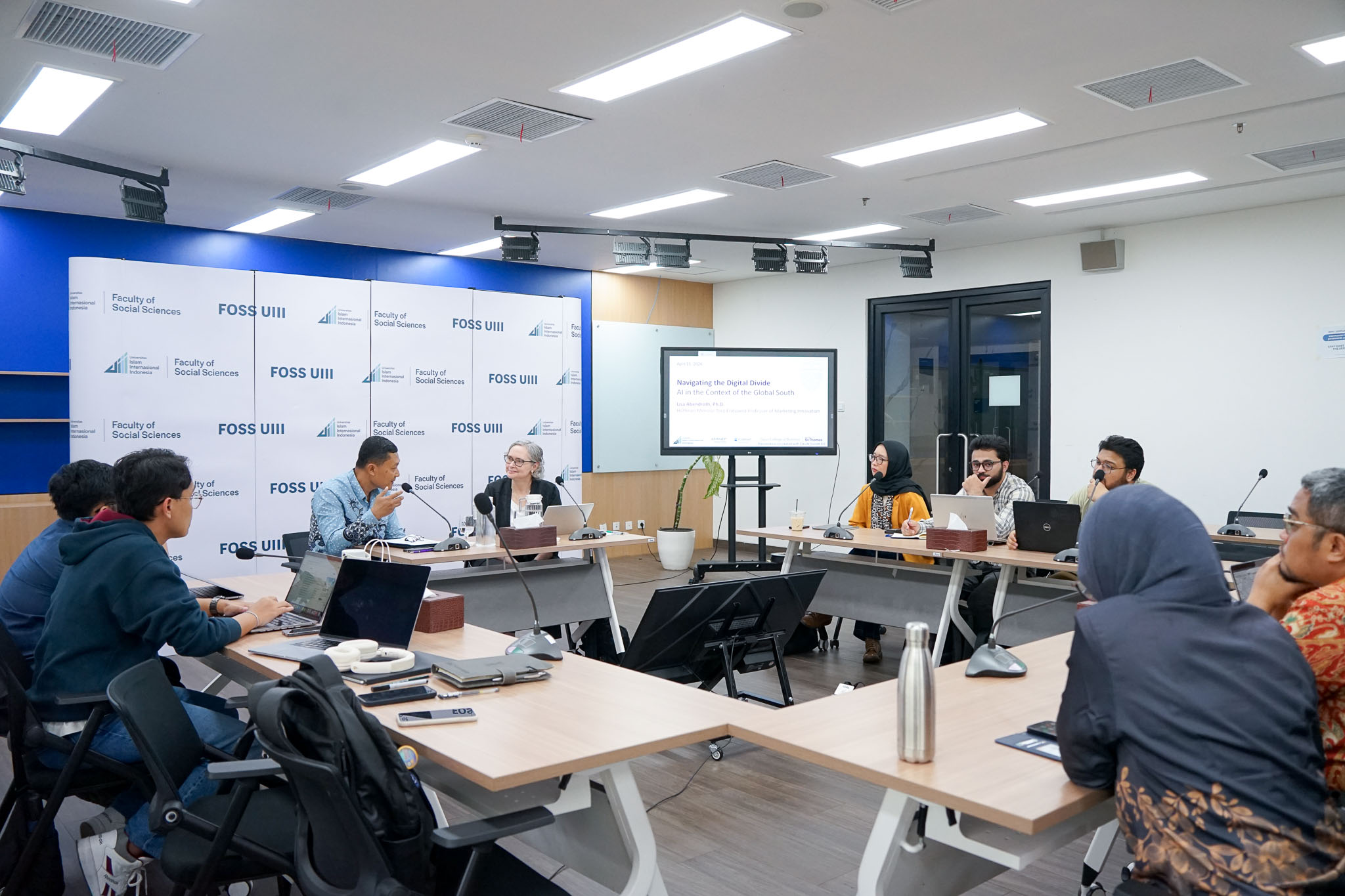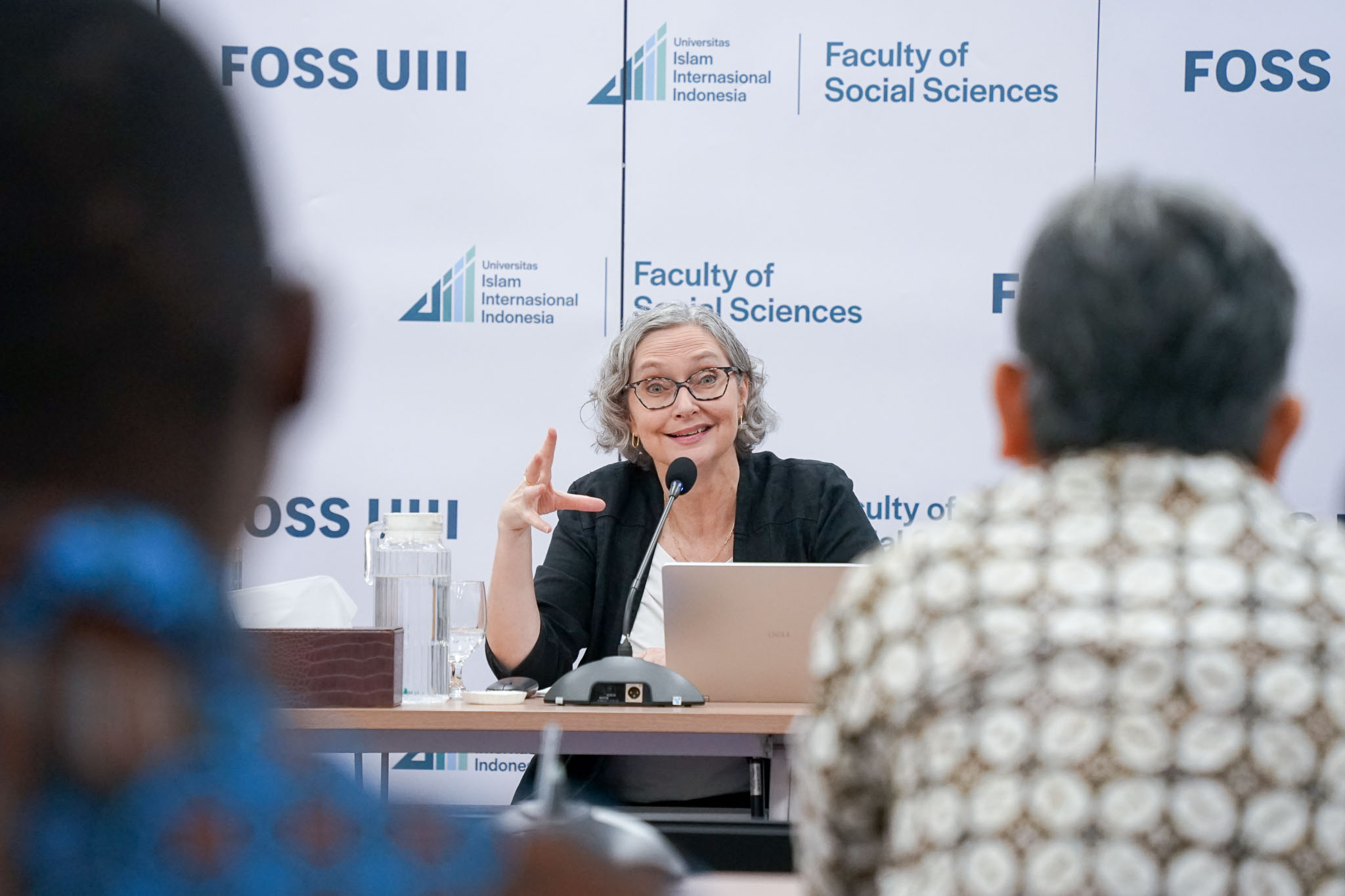
Depok, Indonesia — Universitas Islam Internasional Indonesia (UIII) recently hosted a compelling public lecture titled “Navigating the Digital Divide: AI in the Context of the Global South”, delivered by Lisa Abendroth, Ph.D., Hoffman Melrose Toro Endowed Professor of Marketing Innovation and Associate Professor of Marketing at the University of St. Thomas, USA.
The event was organized through a collaborative effort between UIII’s International Office, the Faculty of Social Sciences (FOSS), AMINEF, and Fulbright Indonesia, as part of the Fulbright Specialist Program.
Dr. Abendroth’s presentation explored how Artificial Intelligence (AI) is reshaping global economies while highlighting the growing disparities between the Global North and the Global South. Drawing from her research initiative “Closing the Market Gaps”, she emphasized that the Global South must not remain a passive bystander in the AI revolution.
“The gap is not closing, it is widening,” she stated. While the Global North adopts AI at roughly twice the rate of the Global South, only about 1 in 6 people worldwide currently use generative AI. AI is rapidly becoming a powerful multiplier of national economic strength, creating both opportunities and risks for developing nations.
Dr. Abendroth outlined three critical gaps that define the digital divide:
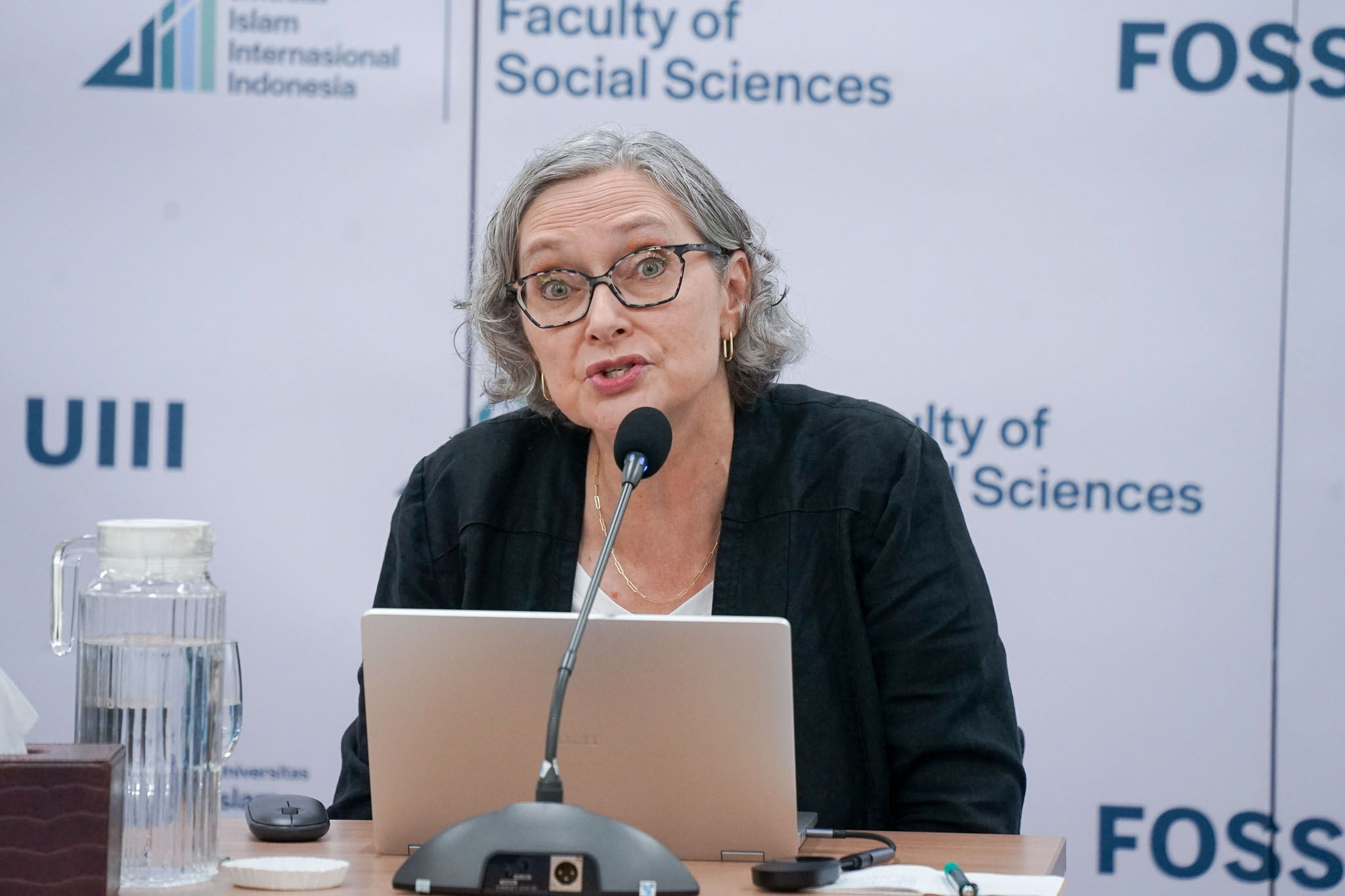
She stressed the importance of foresight, the active consideration of different possible futures, to generate insights that can inform better decisions today. “There is no single inevitable AI future,” she noted. “There are many possible futures.”
The lecture also highlighted positive momentum in the Global South. In February 2026, India successfully hosted the AI Impact Summit in New Delhi, positioning itself as a key voice in shaping inclusive and responsible AI governance.
Indonesia’s AI Ambition and Local Innovation
Turning to Indonesia, Dr. Abendroth acknowledged the country’s strong ambition and growing momentum in AI. Projections indicate that AI could contribute up to US$366 billion to Indonesia’s GDP by 2030. The country already operates more than 80 data centers, and the national curriculum began integrating AI and coding subjects starting in the 2025–2026 academic year.
She spotlighted two inspiring Indonesian examples of context-appropriate innovation:
Dr. Abendroth encouraged the audience to embrace frugal innovation principles found across the Global South, such as Jugaad (India/South Asia) and Gotong Royong (Indonesia), alongside the idea of “bootstrap” innovation, building powerfully with whatever resources are available.
She defined true innovation not merely as novel ideas, but as solutions to real problems delivered at scale, supported by four key elements: commercial scalability, creative destruction, customer centricity, and a “fail fast” mindset.
The talk concluded with a call to action: institutions and individuals alike must adopt a bias toward action, calculated risk-taking, opportunity recognition, resourcefulness, and personal agency, even before conditions are perfect.
Dr. Abendroth also pointed to a reinforcing cycle for bridging the AI gap: innovation (the “what”), and then goes to entrepreneurial thinking (the “how”), and ultimately to resilience (the endurance). While economic factors underpin infrastructure challenges, other predictors, such as mindset, local creativity, and community collaboration, play equally vital roles.
The event sparked lively discussion among UIII students, faculty, and guests on how Indonesia and the broader Global South can actively shape, rather than merely adapt to, the future of AI.