Depok – In an age without printed books, searchable databases, or audio recordings, how did the earliest generations of Muslims determine which reports about the Prophet Muhammad deserved to be trusted?
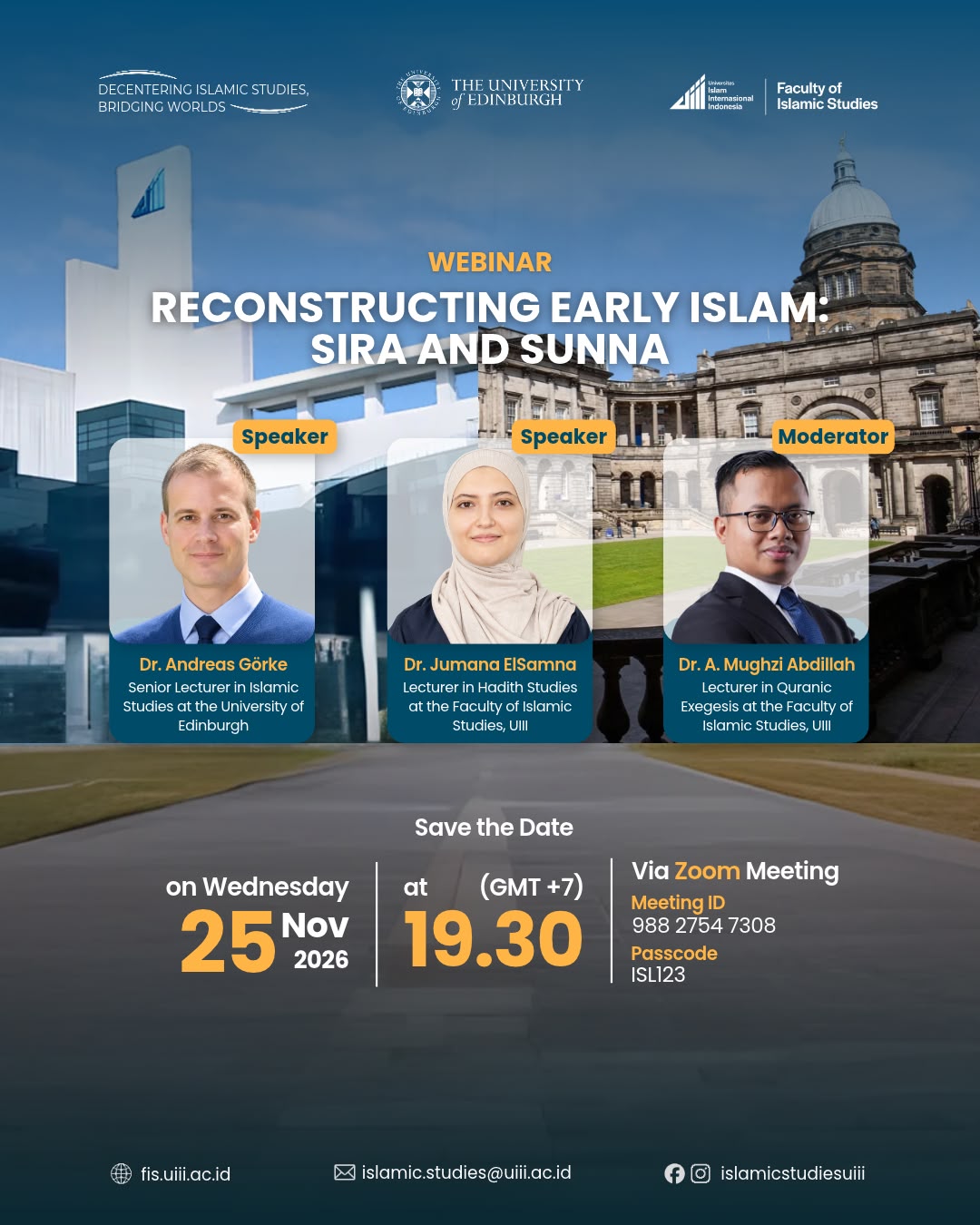
The answer lay in memory, in personal trust, and in an exacting system of scrutiny that was applied to both, and it is precisely this question that will anchor the forthcoming webinar “Reconstructing Early Islam: Sira and Sunna,” jointly organized by the Faculty of Islamic Studies at Universitas Islam Internasional Indonesia (UIII) and the University of Edinburgh. The program will be held on Wednesday, 25 November 2026, at 19.30 WIB (GMT+7) via Zoom.
Dr. Jumana ElSamna, Lecturer in Hadith Studies at UIII, will share the platform with Dr. Andreas Görke, Senior Lecturer in Islamic Studies at the University of Edinburgh, while Dr. A. Mughzi Abdillah, Lecturer in Quranic Exegesis at UIII, will moderate the discussion.
A Tradition Built on Testing as Much as on Collecting
In Dr. ElSamna’s account, the first generations of Muslims did considerably more than gather reports about the Prophet; they subjected each report to careful examination, asking who had related it, from whom that person had received it, whether the narrator was reliable, and whether the content accorded with other reports, with the Qur’an, and with established practice. Moreover, this scrutiny was never confined to the chain of narrators (isnad), since it extended with equal seriousness to the substance of the report itself (matn).
It is here that Dr. ElSamna’s research on ʿĀʾisha bint Abi Bakr becomes especially illuminating. Among the most prolific narrators of the Companions and a leading authority in Islamic jurisprudence, ʿĀʾisha was not merely a transmitter of knowledge but also one of its most discerning critics, for through her istidrākāt, or corrective interventions, she questioned, amended, and re-evaluated reports transmitted by other Companions. In Dr. ElSamna’s reading, this practice shifted the focus of Hadith criticism from the verification of chains alone toward a sustained engagement with content, and it thereby offers an early and instructive model of how Islamic knowledge came to be authenticated.
The early community, in other words, arrived at what it regarded as true not because its members never disagreed, but because they cultivated, with remarkable consistency, a culture of mutual correction.
The Women Who Sustained That Culture
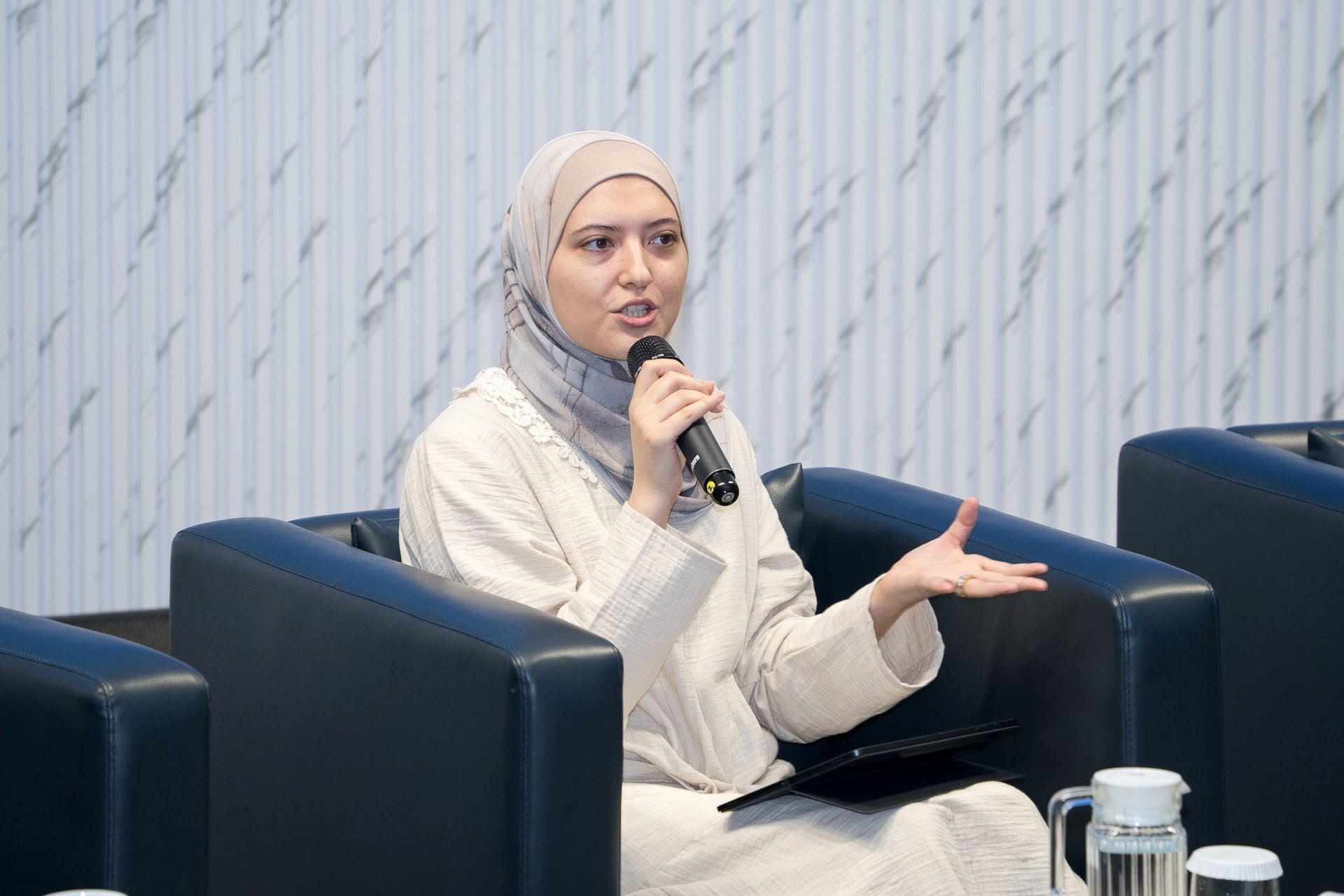
That culture was never sustained by men alone. At a recent UIII public lecture on women’s authority in Hadith scholarship, Dr. ElSamna and Dr. Maryam Qonitat examined the many ways in which women participated in the transmission, preservation, and interpretation of Hadith, emphasizing above all that the acceptance of a narrator was governed by scholarly criteria rather than by gender.
In her own presentation, entitled “The Presence of Women in ʿIlm al-Rijal in the Mamluk Period,” Dr. ElSamna traced the evolution of women’s participation across successive periods of Islamic history. As written Hadith collections circulated ever more widely, new opportunities emerged for women to join established scholarly networks, and the Mamluk era proved especially significant, since the flourishing of educational institutions, libraries, and scholarly circles enabled numerous women to receive and transmit Hadith. Among the figures she highlighted, each of whom was a sought-after authority rather than a marginal presence, were:
– Maryam bint Ahmad al-Azraʿi, whose scholarly network was documented by Ibn Hajar
– Fatima bint Ali, who transmitted Sahih Muslim through a remarkably well-connected chain
– Karima bint Ahmad, who convened regular Hadith sessions in Mecca
These women were distinguished teachers and transmitters, and fellow scholars traveled to learn from them precisely because their chains of transmission, their command of memory, and their intellectual authority carried such evident weight.
A Question That Continues to Resonate
The same thread runs through Dr. ElSamna’s doctoral research, entitled “The Moderation of Imam Al-Bukhari on Women’s Issues through the Chapter Headings of His Book, Sahih Al-Bukhari.” Her study demonstrates that even the most authoritative of Hadith collections must be read attentively, because its structure, its editorial choices, and its chapter headings constitute acts of interpretation in their own right.
This is why the theme of the forthcoming webinar carries such contemporary relevance. Reconstructing early Islam involves far more than reassembling a chronology of events; it requires an understanding of how early Muslims decided what to trust, whom to trust, and by what means a tradition of continual correction preserved its integrity. To omit women from that account is to overlook not merely a handful of names, but a significant part of the process through which truth itself was established.
Event Details