September 7, 2026
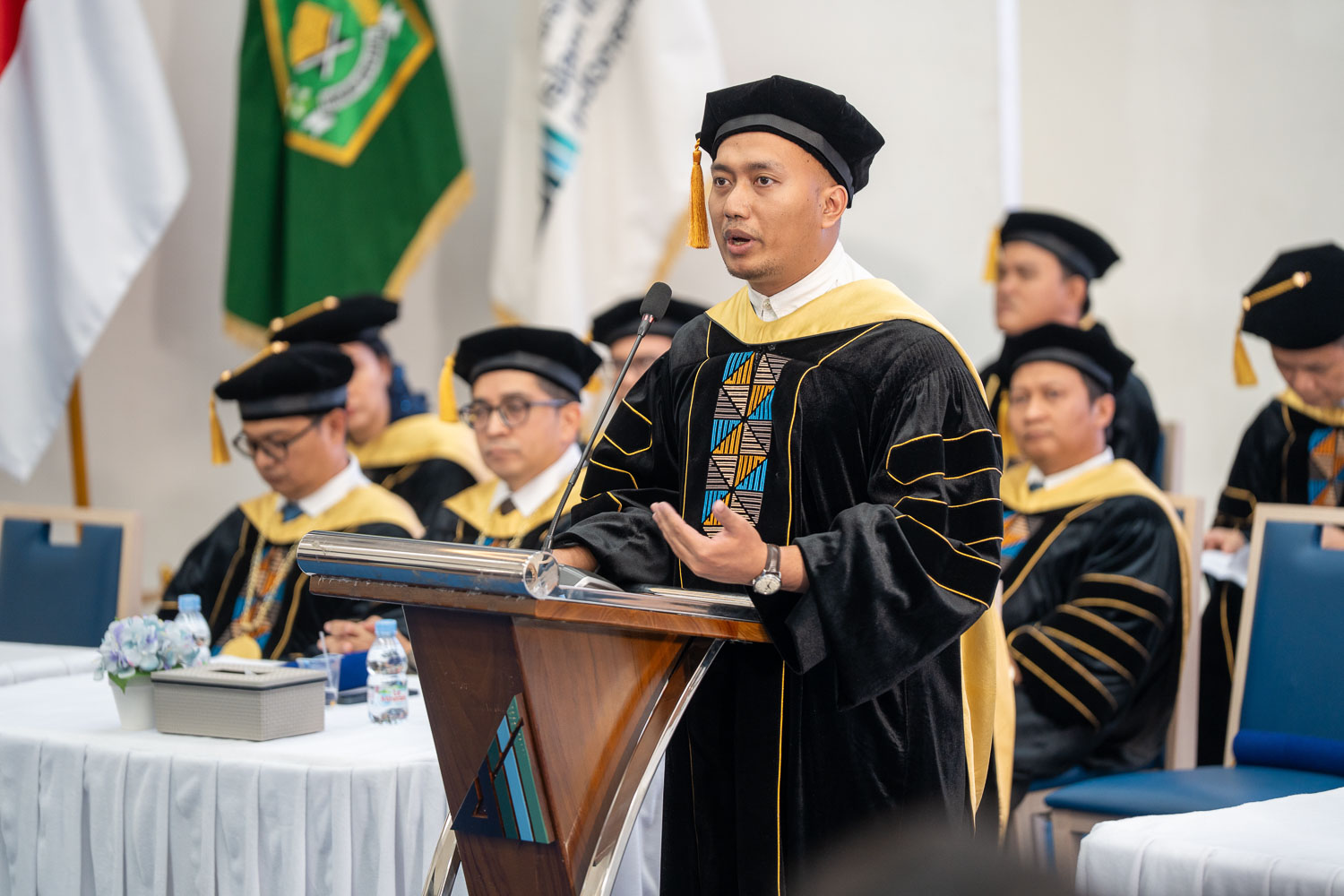
At the 2026 UIII Academic Convocations, incoming students were invited to think beyond the novelty of artificial intelligence and consider a more fundamental question: What role should AI play in how we learn, work, and produce knowledge?
Addressing the new students, Muhammad Al Atiqi, Ph.D., Head of the MSc in Data Science Program at the Faculty of Science and Technology at Universitas Islam Internasional Indonesia (UIII), offered a reflection that moved from the everyday use of AI in classrooms to the global competition surrounding the technology, and, ultimately, to the role students from the Global South can play in shaping its future.
His message was not to reject AI, but to use it without surrendering the very qualities that education is meant to develop.
Lesson One: Use AI Without Losing Yourself
AI is already part of student life. Students use it to improve grammar, draft documents, write code, brainstorm ideas, and work through assignments. For Al Atiqi, the question is no longer whether students will use AI, but why and how they use it.
The problem, he argued, is not simply AI-assisted work. It is the tendency to use AI to avoid the learning process altogether, while sometimes still producing work that falls short of academic standards.
“What really grinds my gears about having too many AI in the classroom is that I know that you are using AI to make your work, but your work is still not up to the standard. So what’s the point of using AI when you are still submitting bad work?”
The distinction is particularly important in a university setting. If AI can generate an entire essay, students may be tempted to ask whether they can let the tool do it. Al Atiqi suggested they should instead ask whether they should.
He illustrated the point with a simple analogy, “You don’t go to the gym asking the trainer to lift the weight. You go to the gym to lift the weight yourself so that you develop strength, you gain muscles, you gain flexibility, but on your own.”
The analogy captures a fundamental difference between using AI to assist learning and using it to replace learning. Just as a personal trainer can guide someone through an exercise without doing the exercise for them, AI can help students navigate a problem without taking over the intellectual work required to solve it.
The distinction also matters because the purpose of a university is different from that of a workplace. In a company, AI may ultimately be judged by its output. If an AI-assisted program works, for example, the immediate objective may have been achieved. In a university, however, the process matters just as much as the result. Students are expected to develop judgment, discipline, critical thinking, and the ability to solve problems independently.
When AI is used primarily to avoid effort, Al Atiqi argued, students risk weakening precisely the abilities they came to university to develop. That responsibility extends beyond the student themselves. “If you’re asking for a human attention, please demonstrate a human effort.”
For Al Atiqi, asking a lecturer, examiner, reviewer, or colleague to spend significant time reading a piece of work also means respecting the time and intellectual effort of that person. “You don’t expect other people to read for one hour deeply on your paper when you only spent five minutes to write it.”
The same principle applies to transparency. Students should be honest about the role AI has played in their work rather than presenting AI-generated material as entirely their own. The point, ultimately, is not to make students afraid of AI. It is to ensure that AI remains a tool for learning rather than a substitute for it.
Lesson Two: No Single Country Owns AI
From the individual student, Al Atiqi expanded the discussion to a much larger question: Who actually controls the technology behind AI?
The answer, he suggested, is more complicated than a simple contest between the United States and China. “It is not just domination between one country. I would not really say that the US wins over everything about AI—or that it’s really just US and China.”
Modern AI depends on a global ecosystem. Behind the models developed by major technology companies are GPUs, semiconductors, manufacturing equipment, raw materials, engineering expertise, assembly facilities, testing, packaging, and logistics networks spread across multiple countries.
The companies developing the most visible AI systems may be concentrated in a few countries, but the infrastructure that makes those systems possible is global. During the speech, Al Atiqi illustrated this with a map of the AI hardware supply chain. For many students in the room, the map also raised a more uncomfortable question: Where is Indonesia in this picture?
Indonesia’s role was difficult to identify on the map, while countries such as the Philippines have increasingly positioned themselves within parts of the semiconductor and technology supply chain, including assembly, testing, and packaging.
For students from Indonesia and other countries in the Global South, the message was not simply that they are behind. Rather, it was that they should consider how to become more actively involved. “What I wish is that for all of us here, who mostly came from Global South countries, is that we can be an active part of developing technology and not just a user.”
The challenge, therefore, is not only to consume technologies developed elsewhere, but to ask what it would take to participate in building them.
Lesson Three: What the Big AI Labs Don’t Have
That raises another question: How can students and researchers in the Global South contribute to AI when they cannot compete with companies that have enormous computing power, massive datasets, and billions of dollars in investment?
Al Atiqi’s answer was to look for something those companies cannot easily acquire: deep local knowledge. “They don’t have real world data that they cannot crawl using simple internet. They don’t know what’s happening in the small alleys in Depok. They don’t know the salinity of water in each sea in Indonesia.”
Large AI companies can collect extraordinary amounts of information from the internet. But there are limits to what can be discovered through publicly available data. They may not understand the needs of a particular neighborhood, the challenges facing a specific community, or the cultural and social context behind a local problem. “The needs of your specific community, only you and your community know. The big company does not know about this.”
This, Al Atiqi suggested, represents an opportunity. Students and researchers do not necessarily need to build the next frontier AI model from scratch to contribute to the field. They can instead develop specialized knowledge, gather meaningful local data, and build applications or models around problems that large technology companies may not have the context, or incentive, to address.
That argument points toward a broader shift in how AI innovation might be understood. The most important contribution does not always have to come from the organization with the largest computing infrastructure.
It can come from someone who understands a problem deeply.
The Growing Value of Original Thought
The argument eventually moves beyond technology and toward the nature of knowledge itself. Al Atiqi suggested that today’s AI systems are exceptionally good at finding relationships between existing information and generating new combinations from what is already available.
“What AI does is make a connection between existing data… but your thought, a really original one, will become even more important than before, because what they can do is just interpolate.”
As AI becomes increasingly capable of synthesizing existing knowledge, genuinely original ideas may become even more valuable. That creates an interesting paradox for universities.
AI can make it easier than ever to produce text, code, images, and other forms of content. But if everyone has access to similar tools and similar information, simply producing content becomes less distinctive.
What becomes more valuable is knowing what questions are worth asking in the first place. For students, that means developing expertise that is grounded in a particular field, community, or problem.
Al Atiqi offered a simple prescription, “Define your corner. Put a field that you care about, a community you want to solve a problem with, and try to defend it. With enough patience and luck, you will probably become an active participant.”
The idea is particularly relevant for students in the Global South. Rather than attempting to reproduce what technology companies in Silicon Valley or other major technology centers are already doing, they can focus on problems that emerge from their own environments.
The small alley in Depok, the Indonesian coastline, a local education challenge, a community’s economic needs, or a particular cultural context can all become sources of knowledge that cannot simply be copied from a generic internet dataset.
Beyond AI: Why Universities Still Matter
Taken together, Al Atiqi’s three lessons were about much more than artificial intelligence. They were about what education is for.
AI makes the question more urgent because it can remove some of the friction involved in writing, coding, researching, and creating. But that friction is not always a problem. Sometimes, it is precisely where learning happens.
At the same time, AI creates an opportunity for universities outside traditional technology power centers. Students and researchers in the Global South may not have the computing resources of the world’s largest AI companies, but they possess something equally important: knowledge of places, communities, languages, cultures, and problems that cannot be fully captured by a global dataset.
The challenge is to turn that knowledge into meaningful research, technology, and solutions. That was perhaps the central message Al Atiqi left with the incoming class.
“Let us not just be a passive participant of knowledge consumption. We here should become an active member that develops the knowledge and technology itself, for the betterment of humanity,” he said.
For students entering university in the age of AI, the challenge is therefore not simply to learn how to use the latest tool.
It is to decide what they want to know, what problems they want to solve, and what knowledge they can contribute that did not exist before.
AI can help them get there.
But the thinking, the effort, and the purpose still have to be their own.
Don’t just consume knowledge. Help build it.