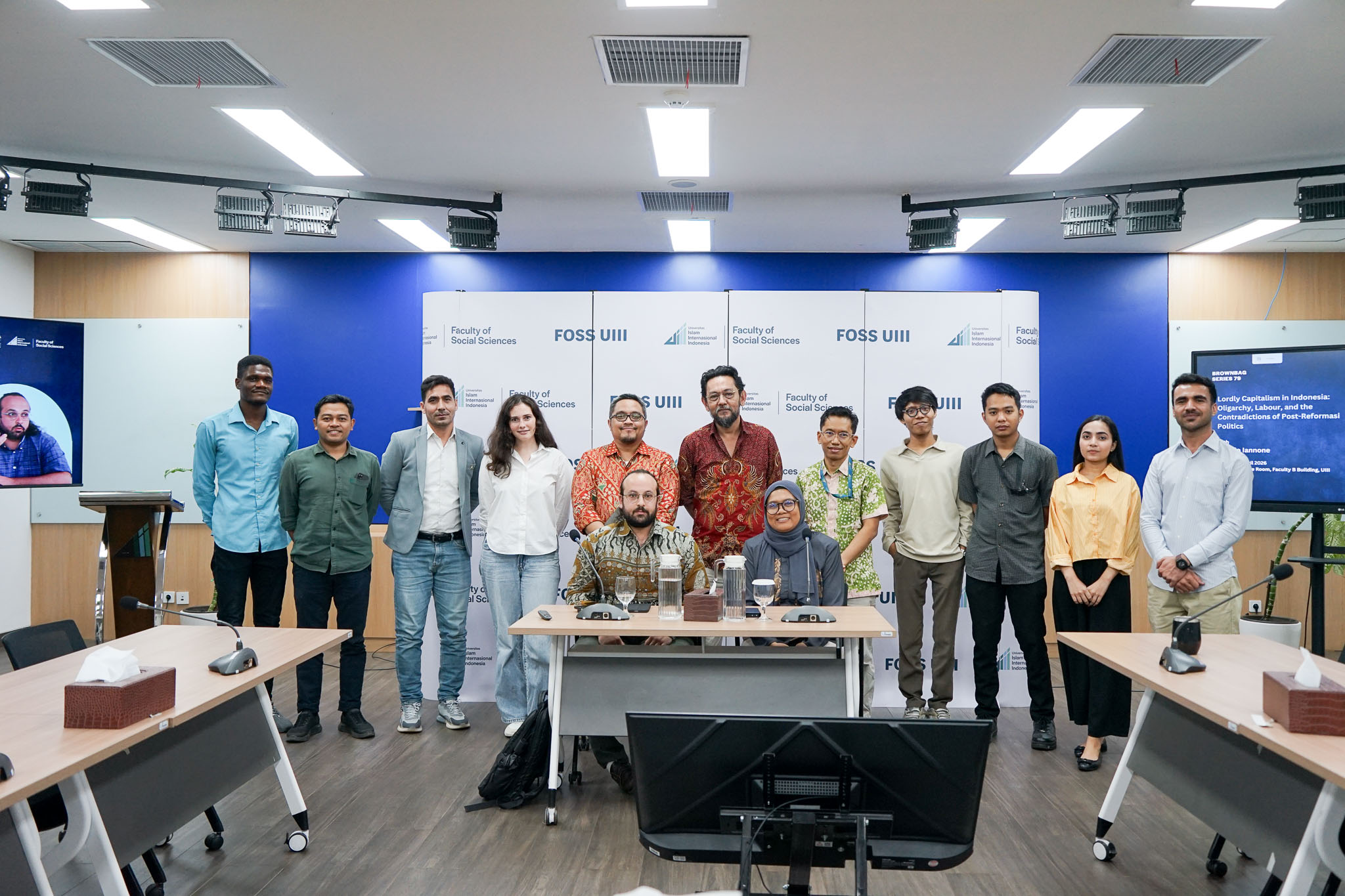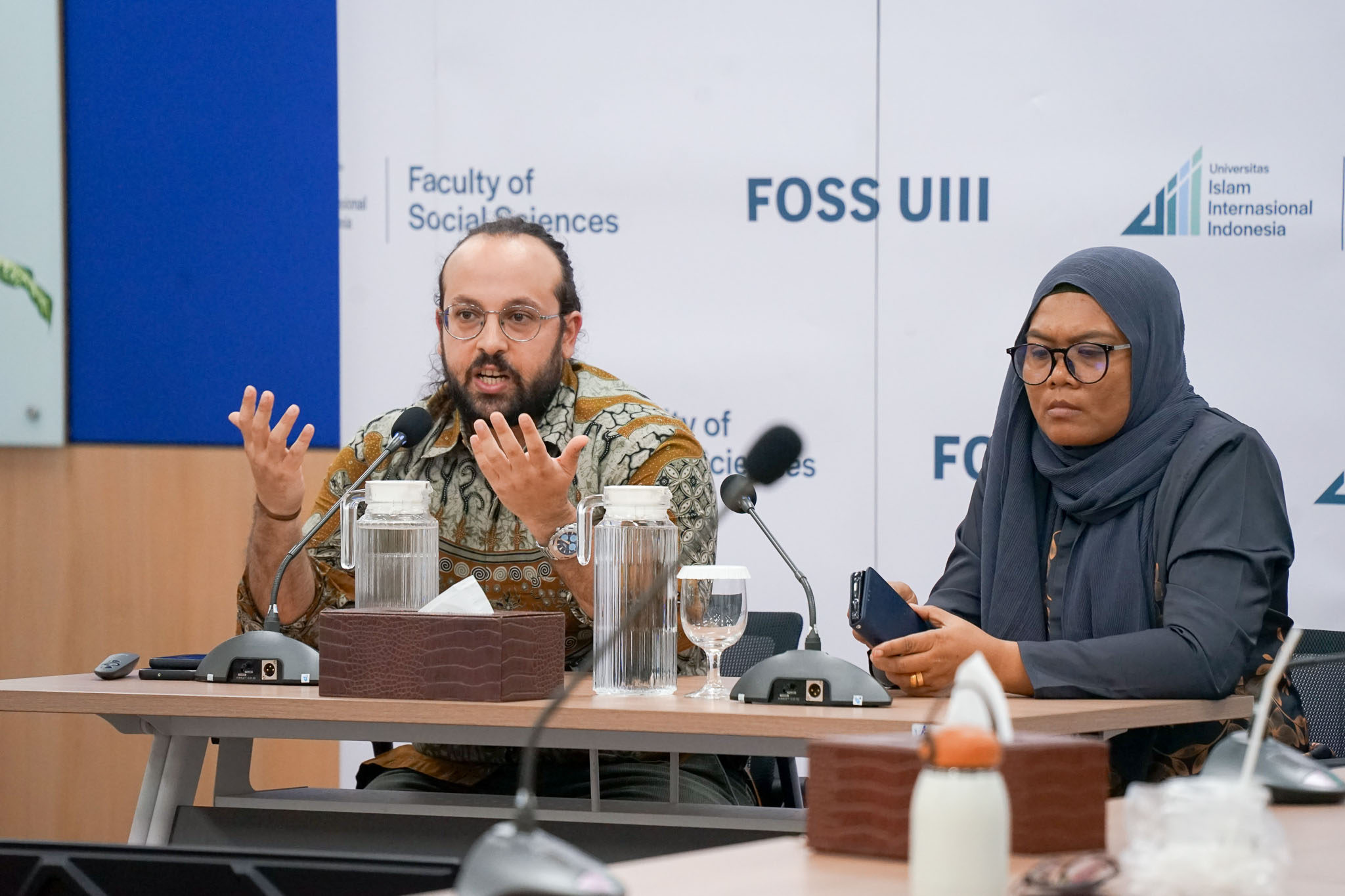
Depok, 15 April 2026 — The Faculty of Social Sciences (FOSS) at Universitas Islam Internasional Indonesia (UIII) hosted a compelling academic presentation today in the Teleconference Room, featuring political sociologist Aniello Iannone. Titled Lordly Capitalism in Indonesia: Oligarchy, Labour, and the Contradictions of Post-Reformasi Politics, the session examined why Indonesia’s vast precariat has failed to translate structural grievances into unified electoral power, using the 2024 collapse of Partai Buruh as a central case study. The event was moderated by Nia Deliana, Ph.D.
Aniello Iannone’s presentation at FOSS UIII offered a powerful synthesis of Marxist, Gramscian, and Althusserian theory to explain the persistence of exploitation in democratic Indonesia. At its core is the concept of Lordly Capitalism, a uniquely Indonesian regime where oligarchic dominance, neoliberal market mechanisms, and moral guardianship combine to sustain accumulation and consent. Elites are framed as benevolent stewards of social harmony (rukun), while demands for labor rights are portrayed as anti-national or unpatriotic. This framework goes beyond traditional oligarchy theory by showing how material extraction is actively moralized and institutionalized.
The historical foundations were traced through a “long durée of labor repression.” From the radical unions of the Soekarno era and the 1965–1966 purge, through New Order corporatism with its Pancasila Industrial Relations (HIP), militarized discipline, and ideological hegemony, to the fragmentation trap of Reformasi. The 1998–2014 period brought legal reforms and union pluralism, yet produced symbolic inclusion rather than real power. Jokowi’s era (2014–2024) completed the absorption of the “outsider” populist, turning blusukan-style legitimacy into new patronage networks and dynastic reproduction, as seen with Gibran Rakabuming Raka.
Central to the analysis was the Electoral Capture loop: high-cost politics reliant on private donations and vote-buying, oligarchic gatekeeping of candidates, institutional barriers such as the parliamentary threshold, and pro-business policy feedback that further enriches conglomerates. This cycle turns democracy itself into an ideological state apparatus that reproduces inequality. The 2020 Omnibus Law (UU Cipta Kerja) represented the culmination, normalizing hyper-precarious labor under the rhetoric of national competitiveness while crushing protests with state force.

Empirically, Iannone’s survey of 709 industrial workers in Central Java revealed the paradox: zero support for Partai Buruh despite widespread precarity, with votes flowing instead to mainstream parties like PDI-P and Gerindra. This “electoral disconnect” and false consciousness stem from suppressed labor movements, commodified alienation, and the moral-ideological dimensions of Lordly Capitalism. The Venn diagram of its overlapping forces: oligarchic control, suppressed unions, elite networks, and worker alienation, illustrated how inequality is sustained even under democratic facades.
Iannone concluded that Lordly Capitalism provides a necessary theoretical advance by merging political economy with ideological and cultural analysis. It explains why democratization failed to emancipate labor and how Global South capitalism relies not only on coercion or clientelism but on the active production of moral consent. The framework opens new frontiers for research into resistance, while highlighting the deep contradictions that continue to shape Indonesia’s post-Reformasi politics.
The presentation drew a packed audience of faculty, graduate students, and labour researchers. A lively Q&A followed, with participants debating whether new digital organising tools or renewed union–civil society alliances could finally break the “hegemonic loop.”