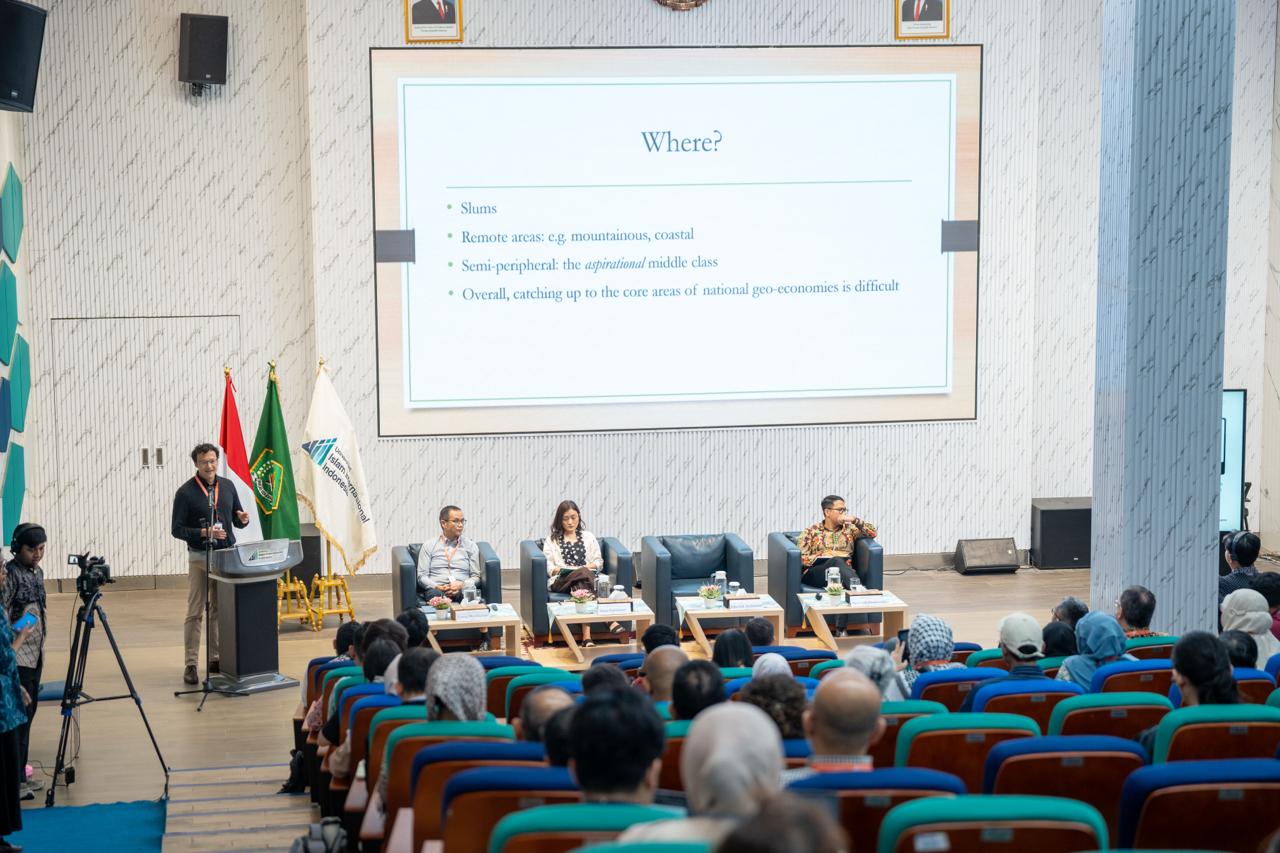
At the 2026 IFAR conference, three scholars laid bare a troubling truth: the water is rising higher than we measure, the wall protects the rich, and the poor are drowning in debt before the floods arrive.
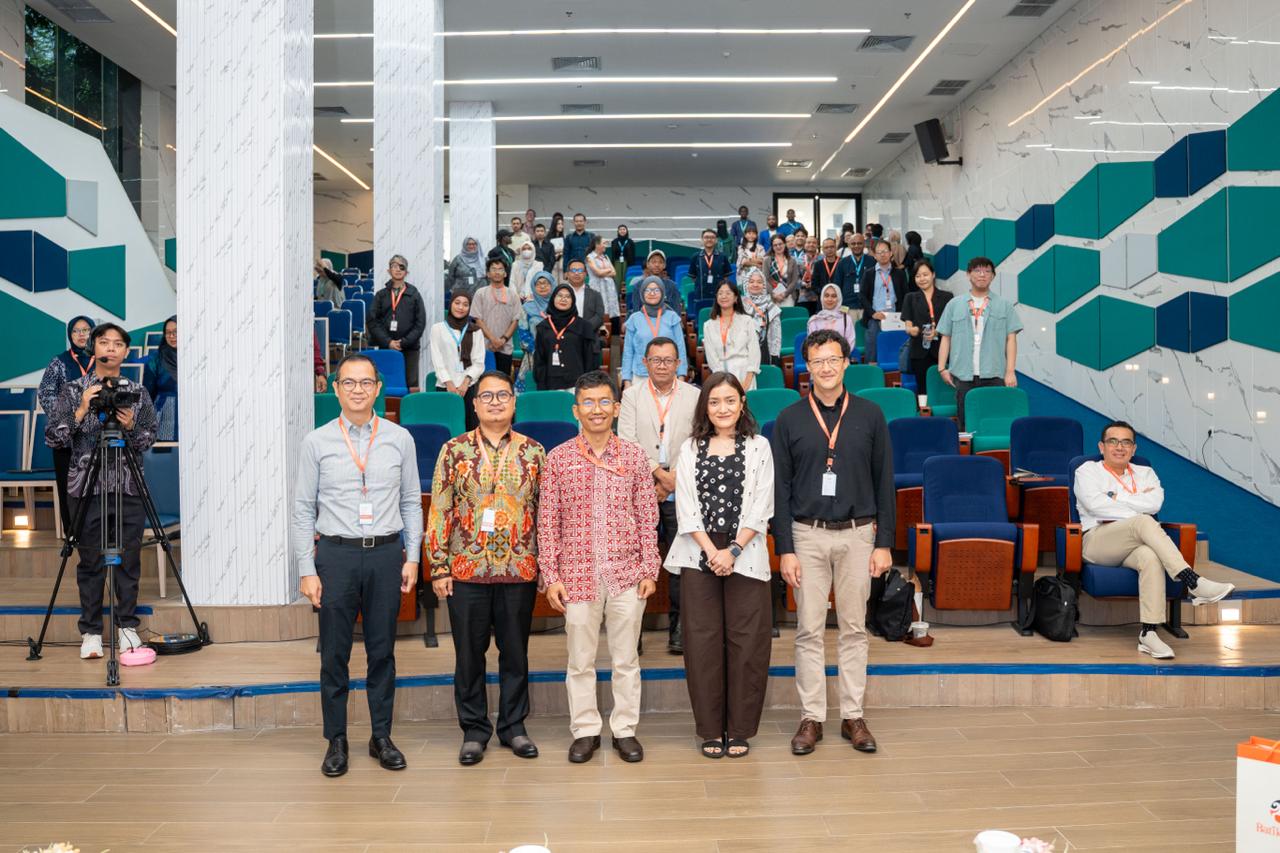
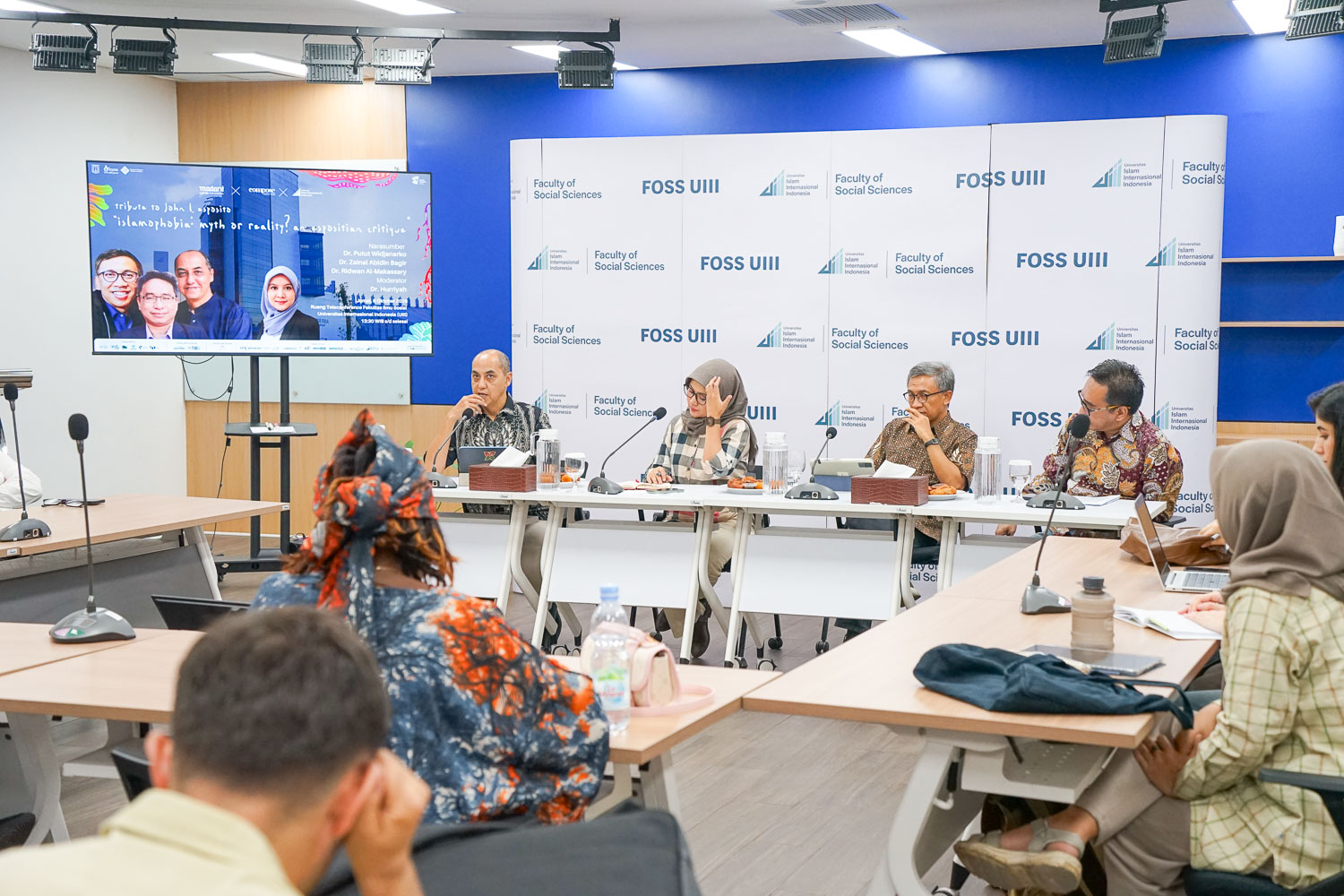
DEPOK — On a humid August morning in 2026, three researchers stood before a room of researchers, policymakers and academics in the Theater Room, Faculty A Building, at Universitas Islam Internasional Indonesia (UIII) in Depok. They presented different slides, different datasets, and different case studies. But together, they told a single, unsettling story about Indonesia’s future—and Southeast Asia’s.
The story begins with a wall. But it doesn’t end there.
The Number That Keeps Changing
First came the measurement problem.
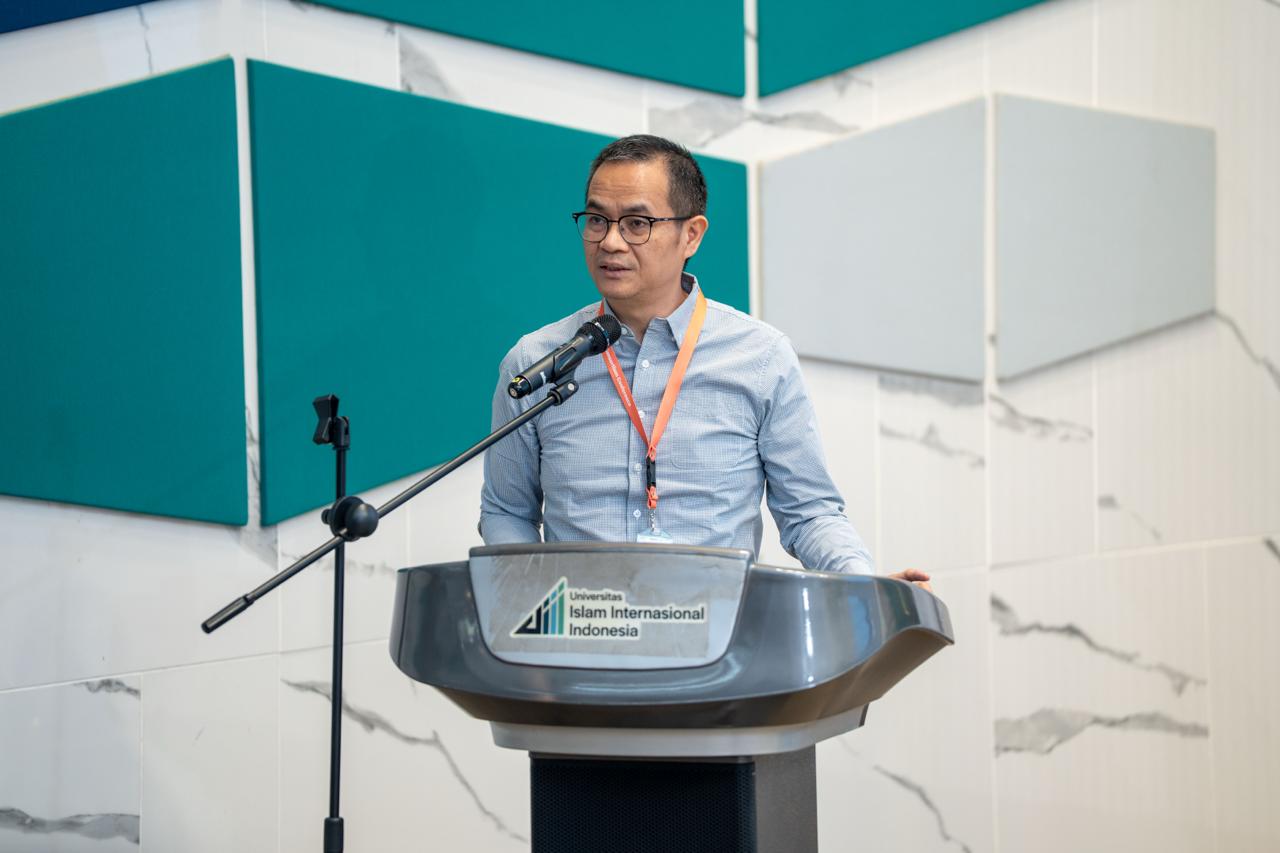
Dr. Sonny Mumbunan, Head of UIII’s Master of Public Policy (MPP) program in Climate Change, laid out the hard data: global mean sea levels have risen by 9.38 centimetres over the past 26 years. The trend is accelerating—from 2.92 mm/year between 1999 and 2009, to 3.82 mm/year between 2015 and 2025.
But here’s the catch: for Southeast Asia, the official numbers are dangerously wrong.
According to a 2026 Nature study by Seeger and Minderhoud, most coastal hazard assessments assume sea level is at the “geoid”—a model of global mean sea level. The problem? Actual local sea levels in the Indo-Pacific are 0.9 to 1.1 metres higher than that assumption.
“Measured mean sea level can be more than 1 metre above global geoids,” Mumbunan quoted. The implications are staggering: with just 1 metre of relative sea-level rise, 48 to 68 percent more people would be affected than previously estimated—up to 132 million people globally, with Indonesia as a primary hotspot.
Rates around Indonesian seas are already higher than the global average—up to 7 mm/year in the western Pacific. The water is coming faster, and higher, than anyone told us.
The Sinking City
But rising seas are only half the story.
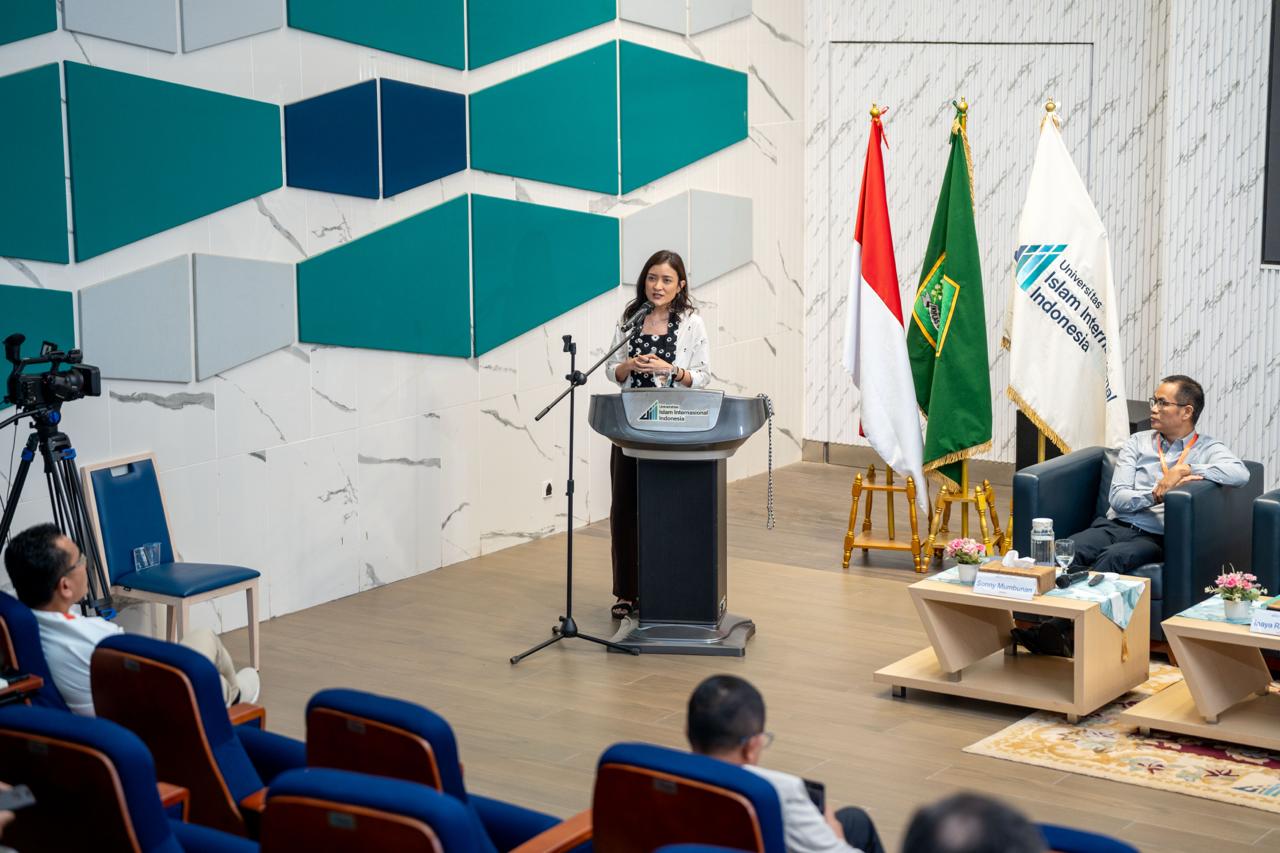
Dr. Inaya Rakhmani, presenting on the cultural political economy of climate inequality, pointed to an inconvenient fact Jakarta’s elites have long avoided: the city is sinking because of industrial groundwater extraction—not just because the ocean is swelling.
Rakhmani argues that even-though engineers know and have informed the local and national governments that the city was sinking because groundwater was being pumped beneath it, the strategy turned seawards anyways.Rakhmani argues that even-though engineers know and have informed the local and national governments that the city was sinking because groundwater was being pumped beneath it, the strategy turned seawards anyways.
Why? Because naming the real cause would implicate industry. And in Indonesia’s postcolonial capitalist structure, industry cannot be disciplined. Rakhmani’s argument, drawing on decades of critical political economy scholarship, is that accumulation in Indonesia proceeds through rents—political access to licenses, concessions, forestry rights, and protected monopolies—rather than productive investment.
The state, she argued, “is constitutive of a weak capitalist class.” It cannot set the terms because capital needs the state for rents. The post-1998 democratisation didn’t dismantle this oligarchy; it merely diffused power across local institutions.
An Imaginary Before It Is a Plan
Enter the Giant Sea Wall.
Rakhmani traced the project’s shifting vocabulary across three decades: from “reclamation” under Suharto, to “coastal defence” under Yudhoyono, to “waterfront city” under Ahok, to “environmental justice” under Anies, and now, under Prabowo, to “sovereignty” and “climate emergency.”
The length keeps changing too. It was 480 kilometres at the United Nations in September 2025. It was 535 kilometres in the authority’s own briefing. It’s now 575 kilometres across fifteen segments.
“An object that keeps changing shape while its necessity holds constant,” Rakhmani observed, “is an object functioning as imaginary before it functions as plan.”
Little has actually been built. Groundbreaking is scheduled for next month. Yet the project already commands 23 ministries and agencies, a dedicated national authority, and a blended financing architecture reaching for Chinese, Japanese, and Gulf capital. The imaginary, she said, is doing “full political work in advance of, and independently of, any infrastructure.”
And whose interests does it serve?
“The wall protects industrial and property assets,” Rakhmani said flatly, “while the costs of enclosure fall on fishers and the urban poor. That displacement is what climate inequality consists of here.”
The Ground-Level Reality
Dr. Edo Andriesse, from Seoul National University, zoomed in on those who bear the costs.
His data paints a bleak regional picture: 306 million Southeast Asians—44.7% of the population—are classified as poor or low-income. Only 117 million qualify as middle-income. Wealth, geography, and the environment are deeply intertwined.
In Bangkok’s Klong Toey slum, around 100,000 people live in self-shaped, unplanned urban areas alongside gleaming modern developments. They face flooding, heat, housing insecurity, and malnutrition. The government’s plan to relocate the port could be an opportunity—or a threat.
In the Philippines’ Palawan province, Andriesse documented the lives of seaweed farmers. Their product is the second-most valuable marine export after tuna, worth US$207 million annually. But a single typhoon can wash away an entire season’s work.
Worse, these farmers are trapped in debt. A key informant described borrowing 20,000 Philippine pesos for a boat, with the lender demanding repayment plus interest within ten months. A local seaweed association president admitted: “I started last year when I quit my office job. These days thirty seaweed growers borrow money from me. There is no written agreement.”
Local elites, not distant corporations, are the gatekeepers of survival. Collective action is nearly impossible when your lender is also your community leader.
The Fiscal Gap
Mumbunan’s final slides connected these micro-level stories to the macro-economy.
Coastal districts and municipalities will face massive adaptation costs—but Indonesia’s current fiscal transfer system (the DAU) only guarantees historical fiscal stability, not future climate risks. “Hold harmless” clauses protect past budgets, not the future.
He proposed a radical rethink: include SLR adaptation costs in fiscal transfers. Rethink how we measure economic growth—using environmental-economic accounting to count catastrophic land loss, mangrove degradation, and freshwater salinisation as real asset write-downs. Integrate these costs into Indonesia’s Nationally Determined Contributions under the Paris Agreement.
In short: the districts that will drown first are the ones least able to pay for the rescue.
What Was Destroyed, and What Was Foreclosed
Rakhmani offered the deepest historical cut.
She traced Indonesia’s technocratic class to a Cold War project: US foundations sending cohorts of Indonesian economists to UC Berkeley. After the 1965 anti-communist purge destroyed the left, that cohort became the New Order’s economic authority. “They were installed as the reason of state by a knowledge-production process whose condition of possibility was the elimination of the alternative.”
The vocabulary of social democracy—of labour organising, of redistributive coalitions—was not just suppressed. It was outlawed. “It was not only the organisation that was destroyed,” she said. “The vocabulary was outlawed, and the ban still stands.”
Today, a declining Gini coefficient circulates publicly as evidence that pembangunan (development) works. But the rising share of the top one percent, the rising material power index, and the dispossession of coastal livelihoods are not measured—not in policy circles, and not in the national conversation.
A University Building the Alternative
But the conference was not just about diagnosis. It was also a demonstration of what is being built.
UIII, which hosted the IFAR conference in its Faculty A Building, has since 2023 offered a Master of Public Policy (MPP) program specializing in Climate Change under its Faculty of Social Sciences. Arguably the world’s first master program of its kind in and for the Global South, it is currently attended by students from 18 countries across the region.
The program, led by Mumbunan, is training the next generation of sustainability leaders to formulate evidence-informed policies for climate mitigation and adaptation. Its students have engaged directly with Indonesia’s National Disaster Management Authority (BNPB), the Ministry of Environment and Forestry, and have represented UIII at COP29 in Baku. The university has also launched the KOMITMEN initiative—an Economic Framework for a Climate-Responsive Indonesia toward Net Zero Emissions—as an academic response to the climate crisis.
The presence of this program at the conference was no accident. The scholars presenting that day were not just diagnosing a broken system; they were, through their teaching and research at UIII, actively shaping the policymakers who might one day fix it.
No Alternative?
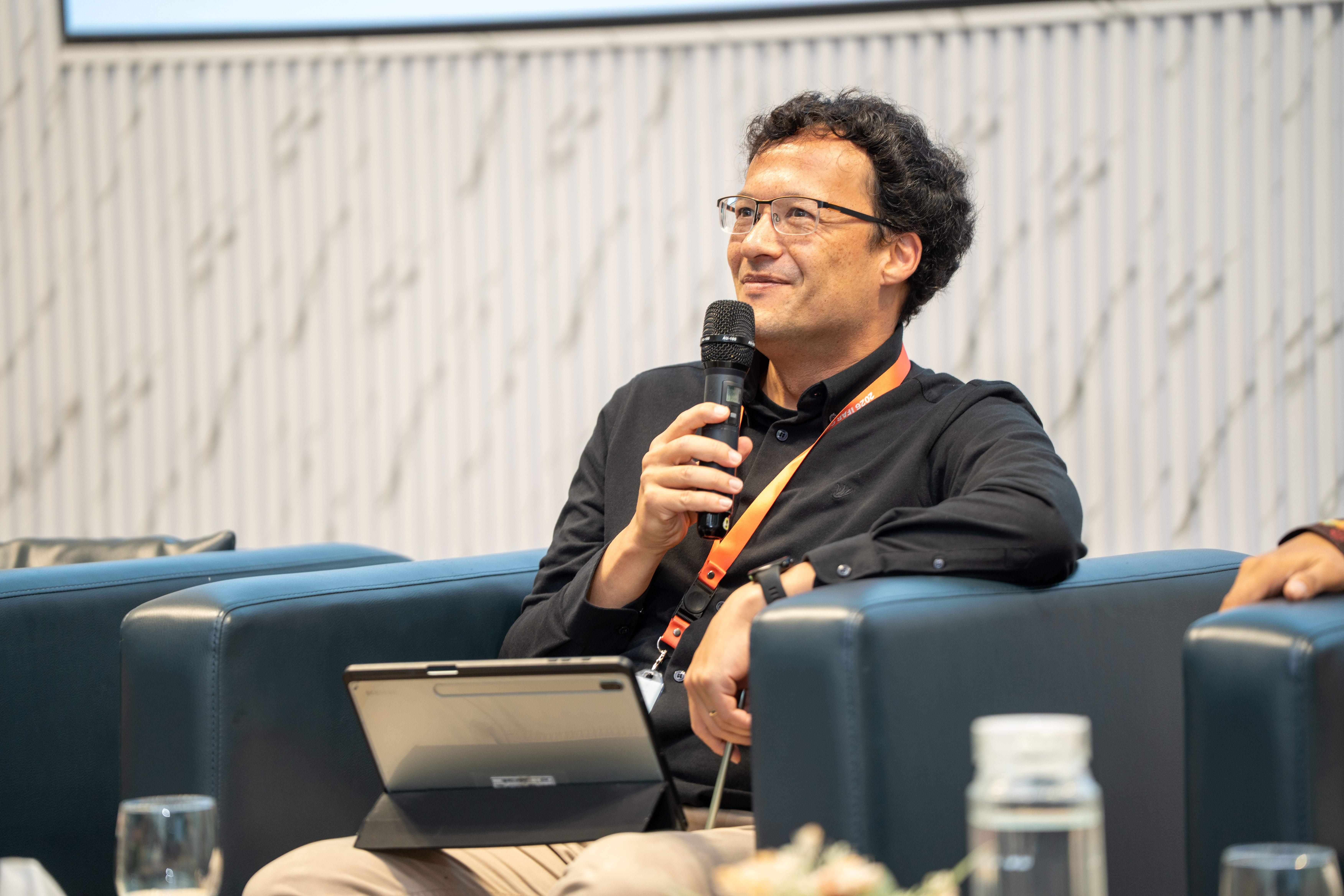
Andriesse quoted Somsook Boonyabancha, a founder of the Asian Coalition for Housing Rights: “Most Asian cities are wealthy now, and they want to be Smart Cities with no room for the poor.”
Ignoring fishers, farmers, slum dwellers, and the aspirational middle class, he warned, “will lead to higher levels of inequality, diminishing national social cohesion, and perhaps even social unrest.”
Rakhmani, however, ended on a note of guarded hope. Kernels of alternatives are being reproduced structurally, she said, “as work becomes more precarious and intellectuals are making sense of this shared lived experience.” Fishers’ assemblies held in pesantren spaces, borrowing an idiom that is available, are producing a counter-causal account: relocating responsibility from an external climate to domestic industrial extraction.
They claim the coast not as an asset, but as a condition of life.
The Water and the Wall
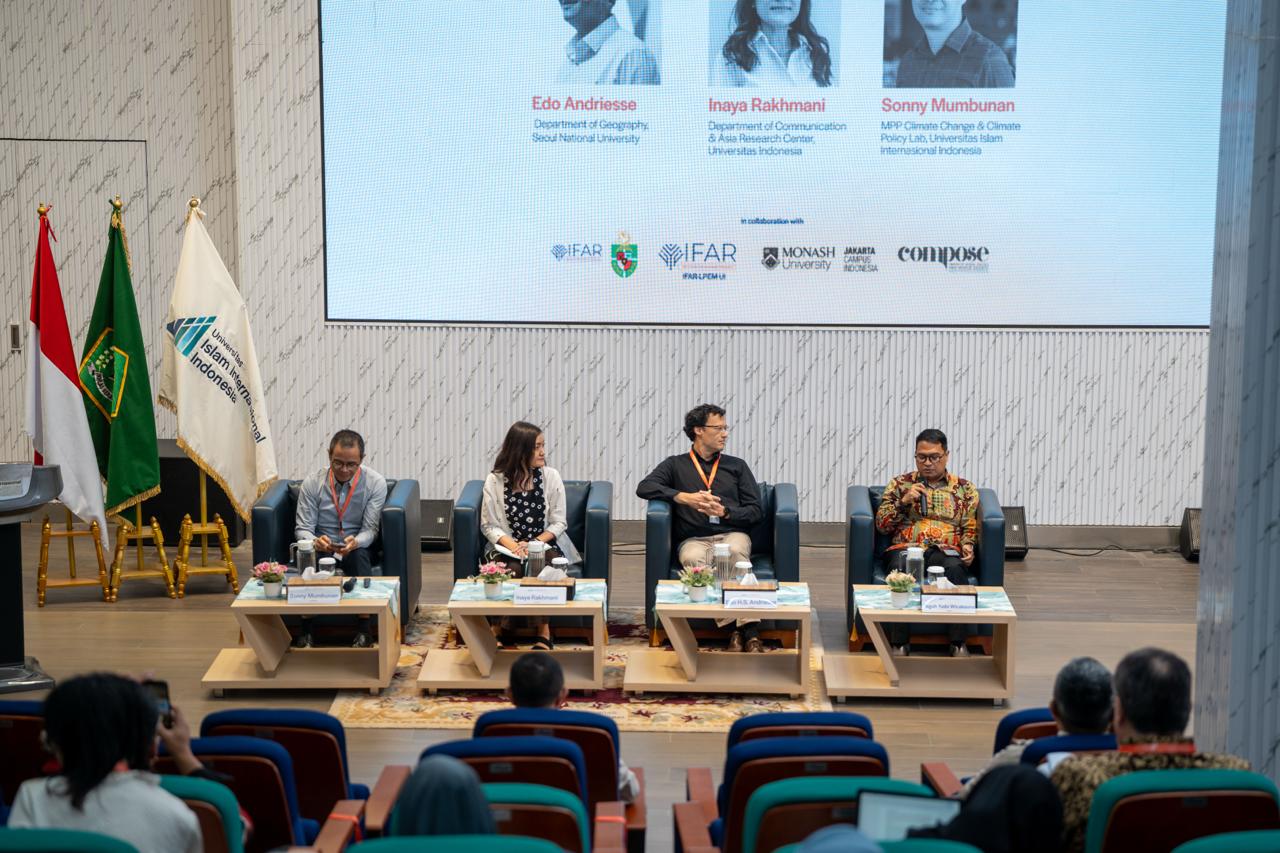
The three talks together form a triptych: Mumbunan shows us the water is higher than we thought. Andriesse shows us who is already drowning—in debt, in slums, in debt traps. Rakhmani shows us the wall being built to protect the few, and the political imagination that makes it seem inevitable.
The sea wall is not just infrastructure. It is a monument to a political economy that cannot discipline capital, cannot measure its own losses honestly, and cannot imagine an alternative that serves the many rather than the few.
The question, as Rakhmani put it, is not whether the wall will be built. It is why “the arrangement is made to appear as though there were no alternative.”
For 77 to 132 million people newly vulnerable to sea-level rise—and for the fishers, slum dwellers, and seaweed farmers already bearing the costs—the answer cannot come soon enough.
At UIII, however, a new generation of policymakers from Indonesia and across the Global South is being trained to ask exactly those questions—and, perhaps, to build the alternatives that have been foreclosed for so long.