October 5, 2026
By Dadi Darmadi
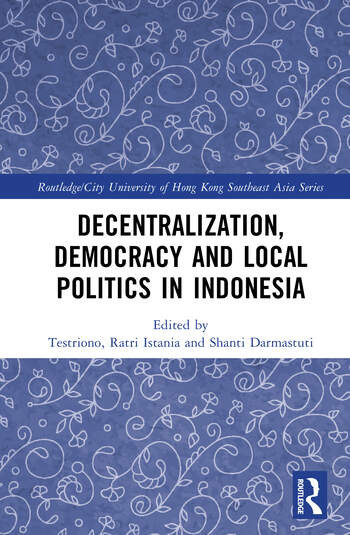
DEPOK, West Java — Testriono, PhD, lecturer and researcher at the Faculty of Social Sciences, Universitas Islam Internasional Indonesia (UIII), has co-edited a new volume published by Routledge examining a quarter century of decentralization, democracy, and local politics in Indonesia.
Titled “Decentralization, Democracy and Local Politics in Indonesia,” the 296-page volume brings together scholars and researchers to assess what more than two decades of decentralization have meant for Indonesia’s local governance, democratic institutions, and political dynamics.
Testriono co-edited the book with Ratri Istania of the National Institute of Public Administration (NIPA) Jakarta and Shanti Darmastuti of UPN Veteran Jakarta. The book is part of the Routledge/City University of Hong Kong Southeast Asia Series.
Since the beginning of the Reformasi era, decentralization has fundamentally reshaped Indonesia’s political and administrative landscape. Authority has been transferred from the central government to provinces, districts, and cities, while direct local elections have transformed the relationship between political elites, bureaucracies, and voters.
The volume examines both the achievements and continuing challenges of this transformation. It explores territorial autonomy and pemekaran, the creation of new provinces and districts, and shows how competition among local elites over new administrative territories can generate both political opportunities and conflict.
The book combines new quantitative data on local democracy and administration with detailed qualitative case studies, offering a broad assessment of how decentralization has evolved and how it continues to shape Indonesian politics.
The volume is organized into three major sections.
The first examines the theory, history, and challenges of decentralization, including a chapter tracing the development of decentralization from the colonial period through the Reformasi era.
The second focuses on bureaucracy and local governance, addressing issues including bureaucratic clientelism, dynastic candidates in direct local elections, power-sharing arrangements in the creation of new provinces and districts, and the development of Papua’s special autonomy following its 2021 revision.
The third section examines strategic issues in post-Reformasi Indonesia, including urban expansion in Karawang, sister-city partnerships, the relationship between decentralization and carbon emissions, and women’s political leadership. The latter includes a case study of Airin Rachmy Diany, former mayor of South Tangerang, Banten.
The volume features a foreword by political scientist Thomas B. Pepinsky and an epilogue by Ehito Kimura, bringing together perspectives on the longer-term political implications of Indonesia’s decentralization experiment.
For Testriono, the publication builds on his longstanding research on democracy and subnational politics. He holds a PhD in Political Science from Northern Illinois University and is also a Senior Researcher at the Center for the Study of Islam and Society (PPIM), UIN Jakarta, and the Populi Center. In 2026, he is serving as an inaugural Lentera Studi Fellow at Kyoto University’s Center for Southeast Asian Studies.
The publication also adds to UIII’s growing contribution to scholarship on contemporary Indonesia. As a faculty member in UIII’s Faculty of Social Sciences, Testriono brings research on Indonesian democracy and local politics into an international academic setting, connecting Indonesian empirical research with broader debates on governance, democratization, and political change.
The eBook and hardcopy editions are now available through Routledge. Readers can also access Chapter 1 through Routledge’s “Preview Book” feature, which provides read-only access to the opening chapter.