February 6, 2026
By Dadi Darmadi
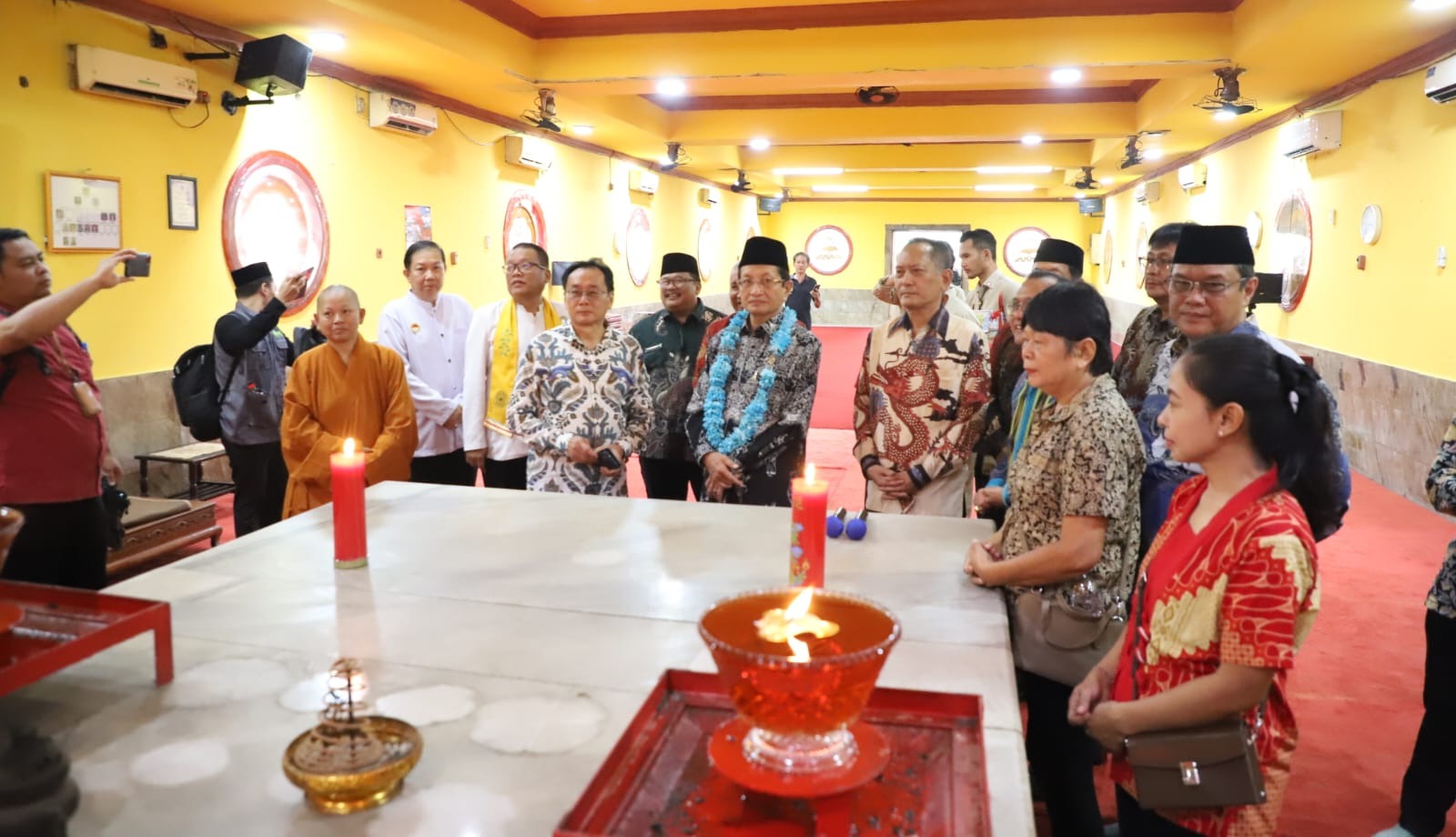
Depok – On a quiet Thursday in Karawang, West Java, the presence of the state took a form rarely associated with bureaucracy or regulation. It arrived not as a policy document or official decree, but as a visit—to a vihara and a kelenteng, places where incense burns, prayers rise, and faith quietly sustains daily life.
Standing at Vihara and Kelenteng Sian Djin Ku Poh, Minister of Religious Affairs Nasaruddin Umar delivered a message that was simple, yet profound: the government has a duty to ensure that every citizen can worship with ease (Thursday, 05/02/2026).
“If someone wishes to worship but does not yet have a proper place,” he said, “our minimum obligation is to make the permit process easier. A sincere intention to draw closer to God should never be obstructed by administrative barriers.”
In Indonesia, where religious diversity is both a social reality and a constitutional principle, the question of worship spaces often sits at the sensitive intersection of faith, regulation, and local politics. By emphasizing facilitation rather than restriction, Nasaruddin reaffirmed the state’s role not as a gatekeeper of belief, but as a guarantor of religious rights.
Learning Tolerance from Prophetic History
What distinguished the Minister’s remarks was not only their policy implication, but their moral framing. Drawing from Islamic history, Nasaruddin recalled an episode from the life of the Prophet Muhammad during his time in Medina. When a house of worship belonging to another religious community stalled due to financial difficulties, the Prophet did not turn away. Instead, he instructed that its construction be completed.
“This,” Nasaruddin noted, “is the true portrait of tolerance taught by the Prophet. His concern for people of other faiths was profound. This is the spirit we must emulate in preserving Indonesia’s diversity.”
By invoking this story, the Minister bridged theology and governance, suggesting that facilitating worship for others is not a concession, but a moral responsibility deeply rooted in religious ethics.
Beyond the issue of permits and buildings, Nasaruddin reflected on the deeper social role of houses of worship. For him, they are not merely physical structures, but moral anchors.
“When people grow distant from places of worship,” he warned, “they risk growing distant from God. And when that happens, the possibility of harming others becomes greater.”
Helping people worship, in this sense, is not only about religious freedom, it is about nurturing better citizens, more grounded individuals, and more ethical communities. The standing vihara and kelenteng in Karawang, with their active congregations, became living proof of that idea.
Tangible Commitment
The visit was accompanied by concrete action. The Minister symbolically handed over Rp50 million in government assistance for the renovation of the worship complex, channelled through the Sian Djin Ku Poh Foundation. While modest in scale, the support carried symbolic weight.
Nasaruddin expressed hope that the funds would not only improve physical facilities, but also strengthen the spiritual life and local economy of the surrounding community.
“We hope this assistance brings broader benefits,” he said, “both for improving facilities and for empowering the community around the house of worship.”
In a country as vast and diverse as Indonesia, such gestures matter. They signal that inclusion is not merely rhetorical, but practiced, quietly, consistently, and on the ground.
Before leaving, the Minister offered a final reminder to the Buddhist community of Karawang: a beautiful building must be matched by a living spirit.
“Do not let the building stand grand and beautiful without people coming to worship,” he said. “If the place is already comfortable, there is no reason to hesitate. The closer we are to God, the farther we are from wrongdoing.”
It was a gentle message, delivered without sermonizing. Faith, after all, is not measured by architecture alone, but by presence, practice, and purpose.
In Karawang that day, the state did not merely regulate religion, it listened, supported, and stood alongside it. And in doing so, it reminded many that guaranteeing the freedom to worship is not only a constitutional duty, but a moral one. []
Universitas Islam Internasional Indonesia