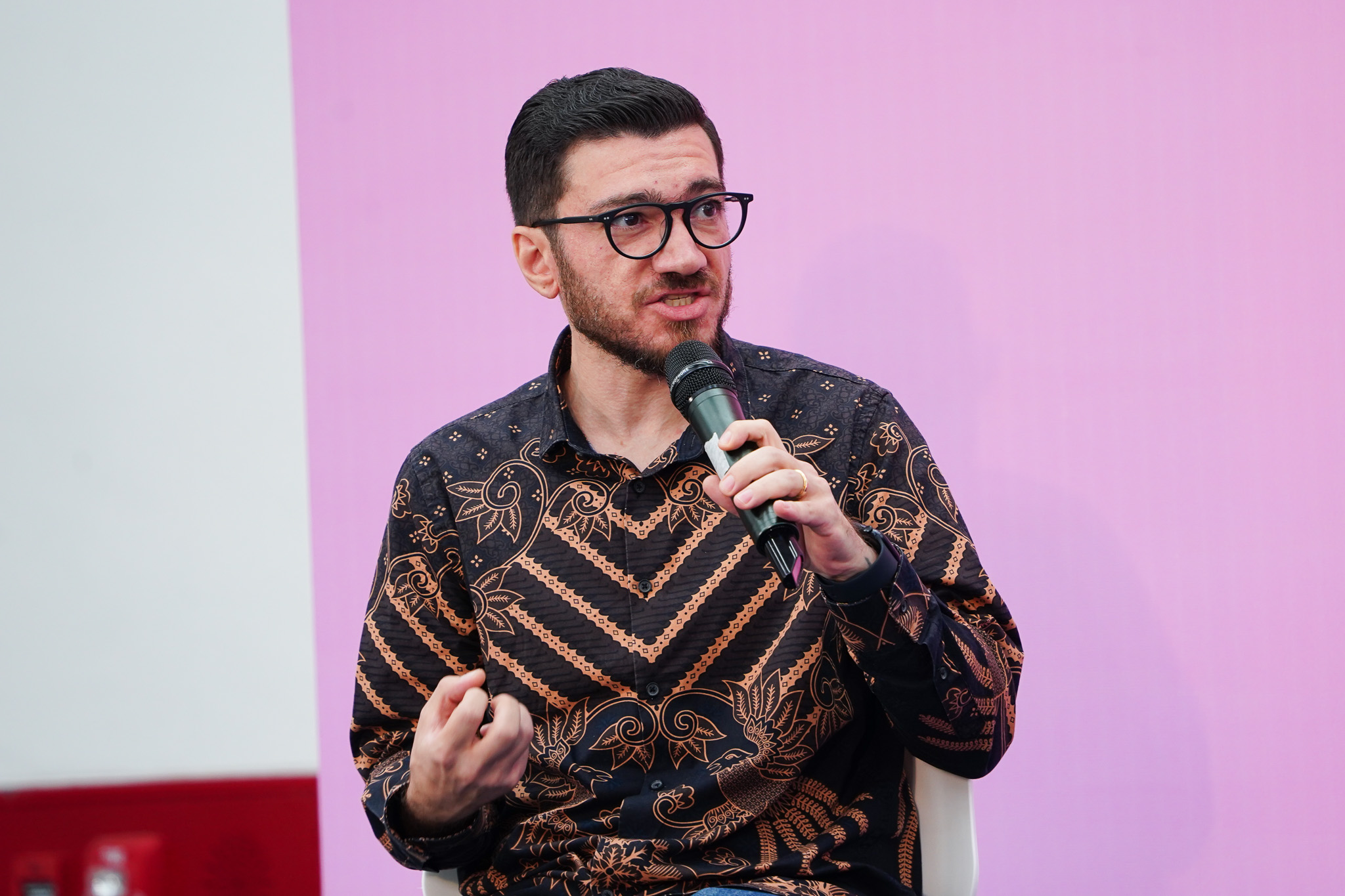
JAKARTA — When asked why he chose to study in Indonesia, Ararat Kostanian, a doctoral student of political science at Universitas Islam Internasional Indonesia (UIII), originally from Syria-Armenia, explained that his love for Indonesia began with his grandfather’s stories about Soekarno.
Childhood memories of seeing photographs of Soekarno, always shown to him by his grandfather, left a deep impression. Those experiences later encouraged Ararat to pursue Asia-Pacific studies during his master’s program at the Australian National University (ANU) in Canberra, with a particular focus on Indonesia.
Ararat’s grandfather was a Syrian-Armenian philosopher and musician who deeply admired Soekarno, especially his ideas on Pancasila and his struggle against colonialism. Whenever Soekarno appeared in the media, his grandfather would point him out to the young Ararat. These stories stayed with him and eventually led Ararat to continue his doctoral studies at Universitas Islam Internasional Indonesia (UIII).
Syria-Armenia and Indonesia
Today, the Armenian people have their own state, the Republic of Armenia, known as the world’s first Christian nation. However, most Armenians live as part of a global diaspora spread across Russia, the United States, Europe, Iran, Syria, and many other regions. They largely adhere to the Armenian Apostolic Church, which is part of Oriental Orthodoxy.
The Armenian diaspora is widely known for its success in business, including in Southeast Asia. In Indonesia, Armenian traces are clearly visible in Surabaya through the establishment of Hotel Oranje, now known as Hotel Majapahit, built by the Armenian Sarkies family. The same family also founded Raffles Hotel in Singapore. On 10 November 1945, Surabaya’s youth took over Hotel Oranje and replaced the Dutch flag with Indonesia’s red-and-white flag. Today, Hotel Majapahit stands as both a witness to the Armenian diaspora and a symbol of the bravery of Surabaya’s youth in resisting colonial rule.
Armenian traces can also be found in Jakarta, where a church building once belonging to the Armenian community is now used as an office of Bank Indonesia. Ragunan Zoo was designed by Benjamin Galstun, an architect of Armenian descent who also served as its first director.
Diversity in Indonesia and Syria
During his time in Indonesia, Ararat began to recognize the country’s unique diversity and religiosity. This ethnically and religiously plural nation has managed to maintain relatively harmonious coexistence. From Sabang to Merauke, people practice diverse traditions, local languages, and religious rituals, while still upholding national unity.
Ararat was particularly impressed by the culture of gotong royong (mutual cooperation) and by religious celebrations that often involve togetherness across faiths.
This experience reminded him of his childhood in Aleppo, Syria. Before the war, Aleppo was known as a plural and civilized city, where Arab, Kurdish, Armenian, and Turkish communities, as well as Muslims, Christians, and Jews, lived side by side in peace. In Aleppo’s markets, the call to prayer blended with church bells and Armenian cultural celebrations. Social life was marked by mutual assistance, tolerance, and openness.
Armed conflict destroyed not only buildings, but also the social fabric and interreligious harmony that had developed over centuries. Memories of pre-war Aleppo stand as a bitter lesson about how fragile civilization can be when sectarian conflict comes to the fore.
Religious Moderation as a Middle Path
Observing Indonesia’s social and religious realities, Ararat was inspired to write about religious moderation as a middle path for managing diversity. In Indonesia, religious moderation is understood as a conscious effort to align religion with national values, so that religion does not become a source of conflict, but instead serves as a bond of unity.
Religion is not removed from the public sphere; rather, it is given a proportional place as a source of ethics, spiritual meaning, and moral orientation in national and civic life. Religious moderation grows out of Indonesia’s historical awareness of the importance of harmony within a highly plural society. From the outset, Indonesia was built upon religious, ethnic, linguistic, and cultural diversity.
Therefore, a religious attitude that is fair, balanced, and non-extreme becomes both a social necessity and a prerequisite for national sustainability. Religious moderation rejects excessive forms of religiosity that close off dialogue, while also avoiding secularization that empties religion of its role in public life.
In everyday practice, religious moderation is reflected in many aspects of social life. Interfaith gotong royong remains common in many regions, whether in social, humanitarian, or public infrastructure projects. Interfaith dialogue is conducted continuously to build mutual understanding and prevent prejudice. Religious holidays are often attended by people of different faiths as an expression of social solidarity, not merely passive tolerance.
For Ararat, living in Indonesia shows that religious moderation is not just a normative concept or a state policy, but a living cultural practice embedded in everyday life. This is an important lesson Indonesia can offer the world: when managed wisely and inclusively, religion can become a strong foundation for peaceful and civilized coexistence.
Kampung Sawah Church
In his research, Ararat compares the lives of Christian minorities living within Muslim-majority societies in two very different social contexts: Indonesia and Syria. In Indonesia, he chose Kampung Sawah in Bekasi as his research site; in Syria, he selected northeastern Aleppo as a point of comparison. These two social spaces, although both once practiced plural coexistence, have followed contrasting historical trajectories.
Kampung Sawah serves as a concrete example of religious harmony in Indonesia. In this area, a Protestant church, a Catholic church, and a mosque stand side by side without sharp social boundaries. Religious life does not operate in isolated spaces, but is integrated with local Betawi culture. Christians and Catholics wear sarung and peci when attending church, much like Muslims do when going to the mosque.
Social traditions such as Ngariung, Sedekah Bumi, and extended-family gatherings become natural interfaith meeting spaces, without being framed as formal tolerance agendas. Harmony in Kampung Sawah grows out of kinship ties, shared culture, and everyday interactions.
By contrast, Aleppo presents a far more painful story. The city was once known as a symbol of pluralism, where Muslims, Christians, Jews, and various ethnic groups lived together. Art, music, poetry, and Sufi practices served as shared languages bridging differences of faith. Yet ethno-political and sectarian conflict has dismantled this order. Aleppo has lost not only buildings and infrastructure, but also its social memory of peaceful coexistence.
Through this comparison, Ararat hopes his dissertation can serve as an intellectual bridge between Indonesia and the Arab world.
Living in Indonesia has led him to experience Pancasila not merely as a normative text, but as a lived practice embodied in everyday life. Indonesia, with all its shortcomings and challenges, can become an important laboratory for the study of religious moderation and peaceful civilization.
The question is: do we truly realize how fragile this harmony is, and are we wise enough to protect it before it is too late?
*) Rector, Universitas Islam Internasional Indonesia (UIII)
This article was previously published here: https://disway.id/read/921983/belajar-kerukunan-agama-di-indonesia/75