January 7, 2026
By Dadi Darmadi
A leading French expert on political Islam finds fresh perspectives at Indonesia’s newest international university
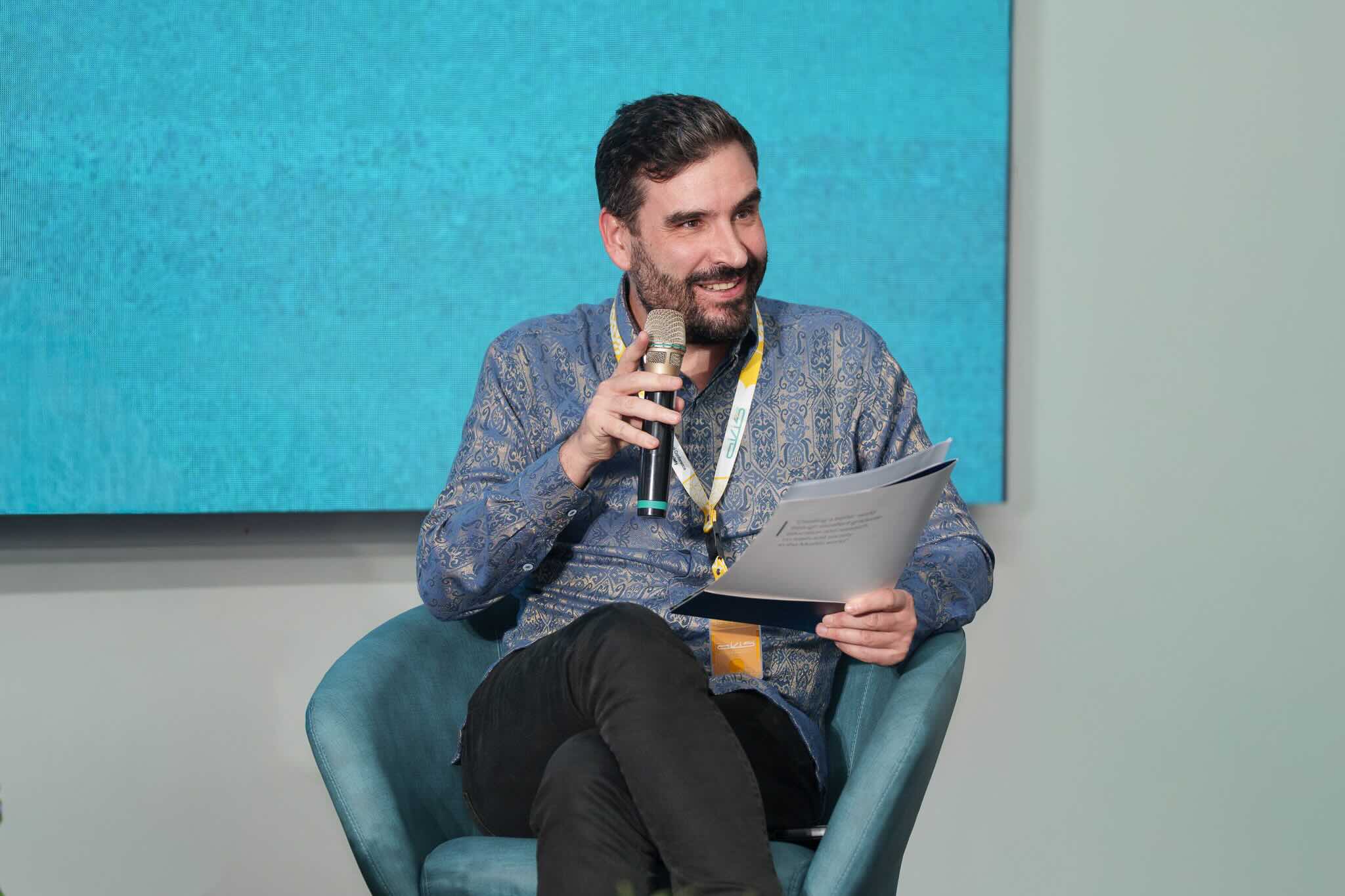
Depok – In the cozy library cafe of Universitas Islam Internasional Indonesia (UIII), amid the steady drum of tropical rain on a Tuesday afternoon in Depok, Stéphane Lacroix savours Indonesian tea while reflecting on his extended engagement with Indonesian academia.
The associate professor at Sciences Po, a renowned authority on Salafism and Islamist movements, has spent significant periods at UIII during the 2024-25 academic year. Initially arriving on a research sabbatical from Sciences Po, with UIII as the host institution, he was designated a visiting professor in the Faculty of Islamic Studies. In this capacity, besides embarking on his new research journey, he actively taught in classes, delivered lectures and workshops, and advised MA and PhD candidates. A subsequent two-month invitation from October to December 2025 as an invited speaker focused primarily on public talks and events.
“I am very happy to be working and conducting research at UIII,” he says. “This is an important project.”
UIII, established in 2016 as Indonesia’s flagship institution for global Islamic scholarship, has quickly positioned itself as a hub for international academics. With faculties covering Islamic studies, social sciences, economics and education, the modern campus in this Jakarta suburb attracts scholars seeking comparative insights into the world’s most populous Muslim-majority nation.
Scholarly Contributions
Lacroix’s academic journey began with a master’s thesis on Yemen’s 1948 revolution in 2002, exploring the intersections of religion and politics, early work that foreshadowed his deep expertise in the field. Fluent in Arabic and shaped by extensive fieldwork in Saudi Arabia and Egypt, he is a senior researcher at Sciences Po’s Centre de Recherches Internationales (CERI) and co-director of its Chair for the Study of Religion. His influential publications include Awakening Islam: The Politics of Religious Dissent in Contemporary Saudi Arabia (Harvard University Press, 2011) and, most recently, Twilight of the Saints: The History and Politics of Salafism in Contemporary Egypt (Columbia University Press, 2025).
His engagement with Indonesia extends well beyond Depok. Lacroix has travelled widely across the archipelago, from Java to Sumatra, Kalimantan to Nusa Tenggara Timur (NTT), and delivered conferences at institutions including Universitas Diponegoro (Undip), Universitas Gadjah Mada (UGM), UIN Yogyakarta, UIN Salatiga and UIN Surakarta.
At UIII, his contributions have spanned teaching, student advising, public lectures, a book forum putting his research on Egyptian Salafism into perspective with Indonesian traditions such as the mass organisations Nahdlatul Ulama and Muhammadiyah, moderate giants that emphasise contextual interpretation and boast tens of millions of followers, and appearances in the university’s podcast series.
In October 2025, Lacroix was among the international speakers at UIII’s hosting of the Annual International Conference on Islam, Science and Society (AICIS+), addressing intersections of Islam, ecotheology and technological change.
Future Research Partnerships
A key research collaboration continues with Prof. Yanwar Pribadi, acting dean of the Faculty of Islamic Studies at UIII, on Persatuan Islam (PERSIS), a modernist Indonesian group that prioritises direct reference to the Quran and Hadith, resonances with the purist currents Lacroix has long studied in the Arab world.
Looking ahead, Lacroix plans a book exploring Indonesian perceptions of “Arabness” and Arab identity, drawing on his experiences across the country to examine how Southeast Asians engage with, adopt or adapt Middle Eastern Islamic models.
His afternoon interview evolved into an informal discussion with university leaders, including vice-rector Syafiq Hasyim, academic senate chairman Riefqi Muna and lecturer Bhirawa Anoraga, underscoring potential for sustained partnerships.
In an era when understandings of Islam are often polarised, initiatives like UIII’s hosting of scholars such as Lacroix highlight the value of cross-regional dialogue. By connecting Middle Eastern scholarly traditions with Indonesia’s pluralistic approaches, such exchanges enrich global Islamic studies and reinforce the country’s growing influence in international higher education. As Lacroix notes, the research interests of local professors and students at UIII offer fertile ground for collaboration that could extend far beyond this academic year. []
Universitas Islam Internasional Indonesia