May 10, 2025
Contributor: Supriyono | Editor: Dadi Darmadi | Photo: Achmad Jatnika

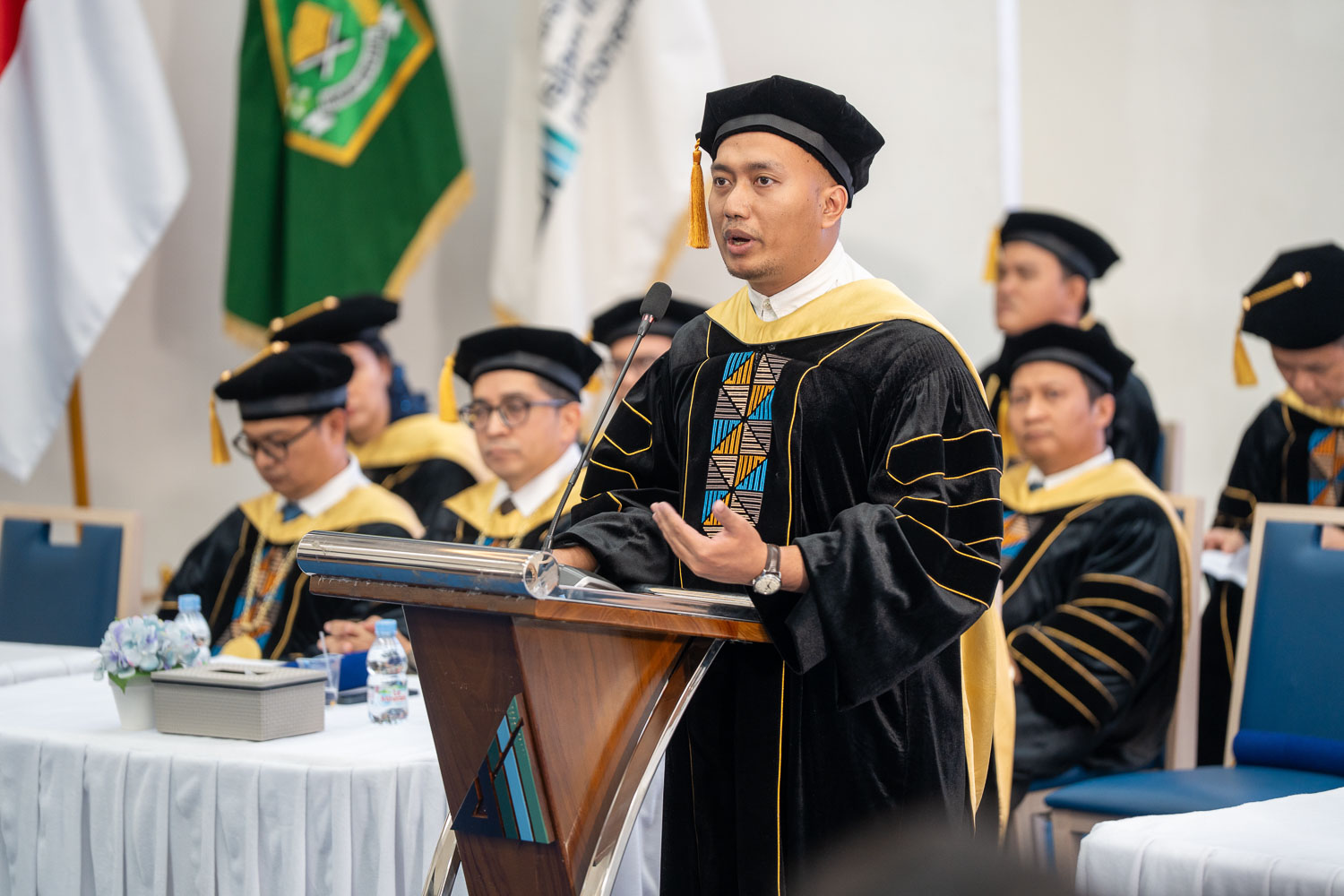
In a compelling presentation at the 4th International Conference organized by UIII Faculty of Education, Dr. Bahrul Hayat, large-scale education assessment expert and former Secretary General of Indonesia’s Ministry of Religious Affairs, emphasized the transformative potential of educational assessment when it is designed and implemented with equity at its core.
Drawing from his rich background in education policy and research, the former UIII Vice- Rector for Academic Affairs argued that assessment is more than a tool for grading—it is a mechanism that shapes the trajectory of learning, access, and opportunity across the education system.
He began by outlining the functions of educational assessment, saying beyond individual student evaluations, assessments are used on a larger scale to track the quality of education systems. When used effectively, he said, assessment provides evidence of how well students are achieving learning objectives and guides decisions related to learning placement, diagnostics, grade promotion, and certification.
However, Dr. Hayat warned its potential drawback, saying that while assessment can help identify learning achievement gaps, support responsive teaching, and inform targeted interventions, they risk to marginalize students by misrepresenting their abilities or limit their opportunities if they are designed with bias, low validity, or without contextual sensitivity. “Assessment has a dual role in educational equity,” he explained. “It can be a tool for justice or a vehicle for exclusion.”
Reflecting on current assessment practices, Dr. Hayat highlighted the multilayered threats. These include rigid item formats, content that lacks curricular relevance, differential item functioning across student groups, and construct-irrelevant variance. On the administrative level, challenges include uniform testing modes, non-adaptive assessments, lack of accommodations, and digital inequality. Additionally, scoring and interpretation practices—such as the use of raw scores, norm-referenced grading, and standardized rubrics—can also introduce bias, particularly when student diversity is not taken into account.
Hence, central to his presentation, Dr. Hayat called for the equitable practice of assessment. He stressed that assessments must be fair, contextualized, and aligned with clearly defined learning outcomes. Students should be given varied and meaningful opportunities to demonstrate their learning, according to their physical and psychological conditions.
To achieve this, Dr. Hayat outlined six foundational principles for equitable assessment: validity and reliability; transparency and accountability; accommodations for special needs; cultural fairness; student-centered design; and opportunity to learn. These principles, he emphasized, are non-negotiable if assessments are to serve their intended purpose of supporting all learners.
Quoting education experts like W. James Popham and Linda Darling-Hammond, Dr. Hayat emphasized that assessments should be tools for learning, not instruments of gatekeeping. “We must ensure that our assessments are fair and instructionally informative, rather than tools that perpetuate privilege or punish disadvantage,” he said. His call to action was clear: the design and implementation of educational assessments must be inclusive, context-aware, and grounded in evidence to genuinely support equitable outcomes for all students.
Dr. Hayat concluded his presentation by urging education stakeholders to rethink the role of assessment not as a final judgment but as an ongoing support mechanism. If done right, he noted, assessments can help reduce learning disparities, inform meaningful interventions, and empower every learner to reach their full potential. His message resonated deeply with UIII’s mission to spark dialogue on how to build a more just and responsive education system—starting with the way we assess.